Dress Journal #4: Excavating the Sewing RoomThursday, March 31, 2011
Dress Journal #4: Excavating the Sewing RoomWednesday, February 23, 2011
GallyFor the first time in nearly two decades, I spent the weekend at a science fiction (SF) convention. Not just a run-of-the-mill, literature-based science fiction convention, nor a costuming convention. Nope: I went to Gallifrey One, the big Doctor Who convention held over Presidents' Day weekend in Los Angeles.
The last SF convention I went to was ConFrancisco, the WorldCon held at the Moscone Center in San Francisco over Labor Day weekend in 1993. We bought the house a few months later, and weekend-long events such as conventions (aka "cons") were left by the way, along with a lot of costuming. It's hard to make the time to build elaborate costumes when paint needs scraping, flower beds need weeding, and money needs to be earned to pay for the work on the house.
I ended up at Gally--the nickname most fans use for Gallifrey One--due to the efforts of one of my fiber friends. Our paths have unknowingly crossed many times in the past thirty years, as we're both geeks interested in science fiction and fiber. After she attended her first Gally a couple years ago, she began bugging me to go, and after last year's con, I broke down and bought a membership. I also set myself some rules:
1) No making myself insane over building elaborate costumes. If it isn't built by the end of 2010, it isn't going.
2) No apologizing for not having elaborate costumes. I have a life, darn it!
3) I will enjoy myself, within reason.
Gally was held at the Los Angeles Airport Marriott hotel: a brilliant choice for a good-sized convention. The hotel is just a few minutes by shuttle from Los Angeles International Airport (LAX), and is large enough to handle the needs of a convention for nearly 2,000 attendees. The hotel also has a very large lobby seating area, strategically placed between the registration desk, a Starbucks, and the bar: the area has become notorious for a multi-day party known as "Lobbycon" as fans hang out to relax, chat, and drink their choice of beverages.
Gally is a "media" con (different from a literature-based con), so many of the panel discussions were about different aspects of the long-running TV show Doctor Who and its spin-off, Torchwood. There were also photograph sessions with actors and actresses who appeared on the series, and autograph sessions with actors and writers. I skipped the photograph and autograph sessions (I'd rather drink and chat with people than bug them for pictures or signatures), caught a couple panels (I especially enjoyed the "Crafting Who" panel), and spent much of my time hanging out in the "TARDIS Lounge" with the other knitters I had previously met online through Ravelry on the Who Knits? board. I earned my keep: the group knits a copy of one of the scarves worn by Tom Baker as the Fourth Doctor each year for a charity auction, and I worked on both scarves over the weekend. I also worked on my own scarf for a future costume.
Science fiction conventions have changed since the last time I attended one. The biggest change is the ready accessibility of social media. On Thursday night, a sign at Lobbycon said, "What happens at Galley is on Facebook in nanoseconds." It's true: as soon as something happened, fans were pulling out their smartphones and tweeting their words and pictures, all marked with #gally. I even managed to send a few tweets myself, mostly about what I was doing and how a long-time costuming friend won the Saturday night masquerade.
All in all, it was an enjoyable weekend; I had enough fun that I sprung for next year's membership. I'm also starting to plan some elaborate costumes for next year's con.
Friday, December 31, 2010
Starting Anew
Once again it's New Year's Eve--time to consider everything that's happened in the past year, and make resolutions (which will be abandoned by January 2).
All in all, 2010 was fairly uneventful. I finished graduate school. The high school I've taught at for the past fourteen years was slated for closure in 2011. I got braces put on my teeth. We pulled the building permits to replace the foundation under the house. We've survived colds, cold weather, and a squirrel in the house. Good-bye, 2010!
Some resolutions for 2011:
1) Blog on a regular basis. I'm really bad about this--I have lots of lovely ideas, but never get around to typing them up. Perhaps I need to invest in a piece of dictation software such as Dragon Naturally Speaking (this is not a plug for them) so I can dictate my email and blog posts while knitting. I'm a bit leery of this software--I tried it about ten or twelve years ago, and it didn't like the way I pronounce certain letters. I'm also not sure how it will respond to my mumbling around my braces.
2) Get back to living a healthy lifestyle. Eat less. Move more. Reduce stress. 'Nuff said.
3) Reduce the size of the stash. The infamous stash has now grown too large for its own good. It's gotten so large that the studio stash closet is full to overflowing, and two tall stacks of bins full of fleece and fiber are stacked in the studio proper. In addition to the bloated stash, I've gone from one loom a year ago to three looms now: I got a Pioneer 16-shaft table loom for sampling in April, and was gifted a 4-shaft Baby Wolf (along with some other equipment) last month. There's barely enough room for me in the studio these days, so reducing the stash should create a bit more space.
4) Get the weaving records organized. I confessed to a bunch of handweavers recently: I am an abject and utter failure at keeping my weaving records organized. How do you keep electronic files, paper notes, photographs, and woven samples all organized neatly? This is a big priority--I've cut projects off two looms in the past two weeks, and both had "issues" because I didn't keep decent records: the five-foot rag rug was actually eight feet long; I used the wrong shade of yellow on some gift towels I was weaving. I need to find a way to keep errors like these to a minimum.
5) Start thinking about life after school. It's time. Barring any unforeseen circumstances, I'm retiring from teaching in less than 61 months. I need to start making some decisions about what I want to do once my life--from August to June--is my own again. Obviously, fiber is going to be a big part of that, but in what ways? As a spinner, a dyer, a weaver, a knitter, a designer, an artist, or a combination of those things? Do I want to design knitting patterns, sell fiber and yarn on the Internet, or create one-off pieces for sale in galleries? Time goes quickly, so if I start thinking about these things this year, I'll have time to take the steps to transition into a very active "retirement."
About the photo: Abracadabra. An original design for a multi-directional lace scarf, knitted from KnitPicks Stroll handpainted sock yarn.
Friday, October 15, 2010
Last weekend's homework for the kids was to "research the steel industry in America" and be ready to report out on Monday. Monday rolled around, and we spent the class period developing a list of "factoids" (thank you, USA Today) about steel. Some of them are dead-on, some are funny, and some are amazingly wrong. Some examples:
- Henry Bessemer developed the Bessemer Convertor in 1857.
- In the 1900s, the United States was the largest producer of steel in the world.
- John Surma is the CEO of US Steel.
- To make steel you need iron ore.
- Andrew Carnegie began Carnegie Steel.
- Carnegie Steel was the largest producer of pig iron, steel rails, and coke in the 1880s.
- Carnegie sold Carnegie Steel the US Steel in 1901. It was the largest steel producer for decades.
- The first steel mill was built in Pittsburgh, Pennsylvania and is the only one left operating. (But what about Gary, Indiana and Fairless, Pennsylvania?)
- The Pittsburgh Steelers use elements of the US Steel logo as their logo.
- Braddock's single largest employer was a steel mill.
- Steel is basic to the world's industrialized economies.
- After 1970, the United States could no longer compete effectively against low-wage foreign producers.
- In 1999, the United States was the second largest producer of steel in the world, with 12% of the market.
- In 2008, US Steel opened the Mon Valley Works Training Facility to train steel workers. (not exactly)
During much of America's history we made things. Many Americans don't know or have forgotten that, from the end of the War of 1812 in 1815 to the start of the Spanish-American War in 1898, the United States did not face east, toward Europe, but faced west toward its own interior. During the second half of the 19th century, America found itself at an economic nexus of resources, labor, capital, and new technology that produced the perfect conditions for large-scale industrialization. America began stitching the ends of the country together with steel railroad tracks, building up into the sky with steel-framed buildings, and opening factories producing everything from buttons to water bottles. At the beginning of the 20th century, Pittsburgh and its outlying boroughs and communities represented one of the greatest concentrations of wealth in the world. The Allegheny, Monongahela, and Ohio river valleys were dotted with steel mills, glass works, aluminum smelting plants and factories, all in need of labor both skilled and unskilled. A few people, such as Andrew Carnegie, Henry Clay Frick, and George Westinghouse, made huge piles of money; other people--the "middle class"--made some money, and a lot of people made a little money, but a lot of people were working and supporting themselves and their families. With the money they made, they bought things--groceries, furniture, clothing, shoes, books and toys--and supported local businesses, which in turn were able to buy the things made in the factories and mills. Like some great Victorian engine, all the cogs and gears of the American economy meshed and turned. This engine worked well: well enough for the United States to declare war on Spain after the USS Maine blew up in Havana Harbor; well enough for the United States to eventually involve itself in the "war to end all war." And then it stopped.

Some parts of economies work in predictable ways. A portion of the economy slows down, so demand other things drops. When demand drops, prices have to drop. When prices drop, supply drops. Since supply drops, less workers are needed for production, so they are laid off. The laid-off workers have less income to spend, so they participate less in the product market, and the process begins anew. The effect spreads outward, like ripples in a pond.
Eventually though, just as the ripples in a pond eventually disappear, the troubles of the Depression waned and American heavy industry went back to work. World War II, as difficult as it was for so many American families, was also a prosperous time: mills and factories ran at maximum capacity, producing everything needed for the war effort. At the end of World War II, America was the undisputed industrial giant of the world.
**To Be Continued**
Saturday, October 09, 2010
On Tuesday and Thursday of this week, we spent some time examining the differences and similarities of Braddock and Vallejo. Let's start with the differences.
Basic Facts About Braddock, PA (15104)
- Geographic size: .6 square miles (roughly 350 acres)
- Population (2000 Census): 2,912
- Ethnicity: 67% African American; 30% white; 1.5% Latino; .25% Asian; and 1.25% everything else
- Median household income: $18,473/year
- Percentage of population living in poverty: 35%
- Largest private employer: US Steel Edgar Thomson Works (900 employees)
- Current economic situation: Declared "Financially Distressed" by State of Pennsylvania in 1988
- Geographic size: 48.8 square miles
- Population (2000 Census): 116,760
- Ethnicity: 36% white; 24% African American; 21% Filipino; 16% Latino; 3% everything else
- median household income: $47,030/year
- Percentage of population living in poverty: 10%
- Largest private employer: Kaiser Permanente Medical Center (3,900 employees)
- Current economic situation: Declared bankruptcy in 2008
Both towns have a long and illustrious history. Braddock was the site of the Battle of the Monongahela, and was named for British general Edward Braddock, who fell during the battle. It was Braddock's young aide-de-camp, a Colonel George Washington, who would eventually lead the Continental Army when Britain's American colonies decided they didn't want to pay taxes levied on them by Parliament after the French and Indian War. In effect, what happened in Braddock eventually led to the United States of America. As the home of the Edgar Thomson Works (established by industrialist Andrew Carnegie in 1875), Braddock is also the birthplace of modern steel industry in America.
Vallejo came about as a gift from local landowner General Mariano Guadalupe Vallejo to the new state of California for a state capitol. Vallejo served as the state capitol for only two years (1852 and 1853), but the United States Navy quickly recognized the value of the site--located at the point where the Napa and Sacramento rivers flow into San Pablo Bay--as a strategic location for a naval base and shipyard. Mare Island Naval Shipyard opened in 1854, and for the next 140 years built and repaired ships and submarines for the Navy.
Both towns have their roots in heavy industry with working waterfronts. Braddock's location along the Mon made it perfect for bringing in the raw ingredients of steel, and then shipping the finished product out to world. Vallejo's location adjacent to Mare Island was perfect for taking steel and turning it into ships.
Both towns have suffered devastating economic losses. Braddock is a town built on steel. As long as steel was made in America, Braddock and many other towns thrived. But as American industries shifted to using cheap foreign steel, mills were closed, jobs were lost, and communities found their economic base pulled out from under their feet.
Vallejo was a Navy town. When running at full capacity, as it was during World War II, Mare Island Naval Shipyard (MINSY) employed about 50,000 workers, and Vallejo's population swelled to nearly 80,000. Although the town shrank considerably after World War II, many Vallejoans worked as "Yardbirds," building submarines during the Cold War. Then, in 1993, Congress voted to close MINSY. Almost immediately, people began to move away and businesses began to close. Vallejo could not withstand the shock. In 2004, the school district was placed under state control when it needed a $60 million loan to keep the schools operating; in 2008, Vallejo became the largest California city to declare bankruptcy.
Two towns: on the surface, as different as can be. But underneath, similar enough for each to claim the other as "my brother from another mother."
Monday, October 04, 2010
I do not enjoy teaching Economics. I didn't care for the subject when I took it in college, and I don't like the textbook (Economics: Principles in Action by O'Sullivan and Shefferin). It's difficult to read, difficult to understand and has, in light of the
current economic downturn, little real relevance. When the textbook was published in 2007, Vallejo's unemployment rate was around 5%; today it's more than 12%. High school students respond to "real world" facts and situations and learn in ways that are not possible when using a dusty, dry textbook.
The current advertising campaign by Levi Strauss & Co. that focuses on Braddock is providing the grist for teaching "real world" economics through something called "Project-Based Learning." In PBL, you use a project to make real the concepts you're trying to teach. It can be exciting, crazy-making, scary, and can blow up in your face if the project or how it's guided aren't carefully thought out. As a result, most teachers don't go for big, unwieldy projects. Most teachers also don't use PBL with their most difficult students, saving it for their "best and brightest," so they can have projects to brag about. This isn't going to be one of those projects. About 50% of my seniors are, to put it politely, credit-deficient. In other words, they may not graduate from high school in June because they've failed too many classes during the first three years of high school. They don't have the grades, they don't have a lot of the traditional skills teachers expect, and they don't have a lot of happiness. They live in a bankrupt town, attend school in a bankrupt district, and are the 48th and last graduating class: their high school is being closed at the end of the school year. A big project built around the similarities of Braddock, PA and Vallejo, CA, and what happens when a big corporation comes in and uses the town for advertising purposes might just be the tool for teaching the concepts of economics in a way that is meaningful to them.
We started on Monday, October 4, by brainstorming questions. For each class (there are 3) I hung up a large piece of butcher paper, put up an image of one of Levi's billboards

and asked, "What questions does this billboard, and another similar one in Oakland, raise?" I was peppered with questions. I didn't answer any of them, I just wrote them down on the butcher paper. When the questions started to slow, I showed The Ad. More questions, more writing them down. At the end of the day, I turned them into a master list of the questions, roughly grouped into four areas:
The Town
- Does Braddock exist?
- Who or what is "Braddock"?
- How is Braddock like Vallejo?
- Is Braddock broke?
- Is there a struggle in Braddock?
- Was Braddock an industrial town?
- What happened to Braddock?
- What's going on in Braddock to warrant the attention?
- Where is Braddock, PA?
- Why is Levi's in Braddock?
- Why is the town so empty?
- Are the people in the ad wearing Levi's?
- Do the people in the ad work for Levi Strauss & Co?
- What are the guys in the advertisement working on?
- What ethnicity are the guys in the advertisement?
- Who are the people in the commercial?
- Who are the people on the billboard?
- Why are the people sad?
- How do the advertisements relate to selling jeans?
- Is "things were broken" referring to the rivets in Levi's?
- Is the billboard some type of inside joke?
- Is the commercial a "mini-movie"?
- What is meant by "Go Forth"?
- What is the billboard about besides Levi's
- What is the commercial's message?
- What is the meaning of the narration/voiceover?
- What is the company advertising?
- What's with this campaign?
- Where are the jeans?
- Why does the billboard say "Braddock, PA"?
- Why is an advertisement featuring Braddock in Oakland (CA)?
- Is the advertisement to raise money for Braddock?
- Does money from the sale of Levi's go to help Braddock?
- Is Levi's doing a charity in Braddock?
- Is Levi's giving discounts to poor towns?
- Is Levi's lowering their prices?
- Is Levi's trying to sell jeans by suing sympathy?
- What is the connection between Levi's and Braddock?
- Why are Levi's supporting another state?
- Are we (who is "we") willing to fix Braddock?
- Does wearing Levi's expand your horizons?
- How can we help Braddock?
- Is everybody's work equally important?
- What does this have to do with Economics?
- What is a "frontier"?
- Why isn't Levi's helping Vallejo?
- Why should we care about Braddock?
- What can we learn from this to help Vallejo?
Sunday, October 03, 2010
I was sitting on the divan watching the season premiere of The Simpsons when I finally saw The Ad. I'll admit it--I haven't been watching a lot of TV this year, and when I do, it's usually programs that I've recorded so I can fast-forward through all the commercials. I was watching the actual broadcast, so I couldn't "zap" through the commercials. I saw It...twice.
The first time I saw It, I was rather annoyed (I find most of Levi Strauss' commercials annoying), but something looked familiar about the background. Something about the trees on the hills, and the way the town looked, full of old houses and narrow streets. The quick cut to the "Welcome to Historic Braddock" sign registered on my subconscious; the "Braddock, PA" at the end merely raised the question, "Why was Levi's shooting an ad in Braddock?" It wasn't until until the second time The Ad aired (during Family Guy, if I remember correctly) that it struck me: This was Braddock, PA. No wonder the hills and backgrounds looked so familiar--it was home. I sat there, stunned.
Once the sickening shock wore off, I was angry. Angry that Braddock--and by extension, the other little towns and boroughs of the Mon Valley--were being shown in such a light. Angry that Levi Strauss & Co., the largest jeans company in the world would exploit the people of my home in such a way. Angry that Levi Strauss would travel nearly 3,000 miles to make such a commercial, yet ignore the problems in their own San Francisco backyard. Levi's produced a "feel good" commercial about their product, which they don't even make in the United States any more. Grrrrrrrr!
The commercial broke my heart. Here was Braddock, looking as it probably did in the depths of the Depression, with hardly enough population (2,912 as of 2000) to sustain itself. Braddock's story isn't very different than other towns--the economy of areas such as Braddock, North Braddock, Rankin, and Homestead collapsed when the American steel industry collapsed and, in many cases, have yet to recover.
Sometimes good things can come out of shock, anger, and sadness. I'm teaching Economics to about 100 high school seniors this semester, in a town that has been economically rocked as Braddock has been. Perhaps this can be turned into a "teachable moment."
Friday, October 01, 2010
These Roots are Deep
I’m proud of my roots. My very blue-collar roots are sunk deep into the coal-laden Allegheny Mountains and watered by the Monongahela River. Different parts of my rather large family tree have lived within 20 miles of “the Point”—the place where the Allegheny and Monongahela rivers meet to create the mighty Ohio River—for at least 150 years; I have a letter from my great-great-great-grandfather dated 1863 describing life on his farm just outside Elizabeth. My dad’s family lived in Carrick and later Mount Oliver; my mother grew up in Hays (her father worked at National Tube in McKeesport). I was born in Pittsburgh and went home to a house in Baldwin. Pittsburgh was home—imprinted on me the way a specific patch of gravel in a specific creek is imprinted on a salmon--even though circumstances required this part of the family be transplanted to Southern California. I grew up in the vast suburbs outside Los Angeles, went to college, married, and established my own household, but home was always right around the corner, in the way the light strikes a group of buildings, or the tantalizing scent of woodsmoke on a crisp fall evening. The imprinting runs as deep as the roots: when traveling to Washington D.C. by train, I knew when the train passed through Pittsburgh and up the Mon Valley in the middle of the night, before I peeked out the window to catch a glimpse of the hills and bluffs of West Mifflin. Later that same trip, I became hopelessly lost coming into Pittsburgh from the Pennsylvania Turnpike; I hadn't been there in nearly 25 years, had never driven in the city, and simply didn't know which offramp led to what bridge. I ended up at East Carson Street in South Side and, on a hunch, turned left. It felt familiar, and then I saw a sign for the Blue Belt at Beck's Run Road. I knew where I was, turned right, and fifteen minutes later was in front of the house where my father grew up in Mount Oliver.
I live in Vallejo because it reminds me of home. While visiting a friend, I fell in love with the town: little old houses marching up and down hills to a working waterfront dominated by the big brick industrial buildings of Mare Island Naval Shipyard. I felt like I was home.When we could, we moved to Vallejo, found a wonderful old house to love, and put down new roots. It's not quite home, but it's pretty close.
Tuesday, June 29, 2010
June has been nuts. Not cashews, walnuts and pistachios; way too much stuff to do crammed into too few days. There have been 5 fiber-related events during the 4 weekends in June, along with two graduations and a trip to Oregon. The events have been:
June 5--Spinning at the Winery fiber picnic
June 6--Grad school graduation exercises
June 10--High School I teach at graduation exercises
June 12--Spinning at the Farm fiber picnic
June 16--Leave for Eugene, Oregon
June 17-20--Black Sheep Gathering
June 21--Arrive back from Eugene
June 26--Spinning demonstration at San Francisco's Exploratorium museum
June 27--Spindles & Flyers guild meeting; Oakland Fiber & Textile Festival
All of them have been fun, and a lovely way to shift gears from teacher to fiber artist, but the studio has suffered...badly. I haven't been home enough to put away things that didn't get put away during the school year, and it seemed that I dragged home more fiber and equipment from nearly every single event. The past several days have been devoted to bringing order to my corner of chaos, and I made a big discovery:
There is a limit to what I can fit in the studio.
That brings me back to my header. At CNCH in April, I ordered a 16-shaft, 20" wide Pioneer loom. I took a good look at them at CNCH, and was impressed by the quality construction, the size, and the fact that, with 16 shafts, I could weave some pretty elaborate small projects and samples. The loom--after some travails including FedEX dropping it several times--arrived on June 4. I barely had time to uncrate my new toy before the round of fiber festivals and events started, so it sat on the dining room table for nearly 4 weeks until I could get a small table and move it up to the studio.
Once I took some measurements, I realized that the only place the new table and loom would fit was where 2 file cabinets have been for years. No problem--just move the file cabinets. But where? If I moved the small chest of drawers full of art supplies next to the storage closet, I might have room for the file cabinets. But where should I put the chest of drawers, as it's too big to fit under the table? I did a bit of rearranging in the laundry room, and moved it out next to its twin, also full of art supplies; problem solved. Once the chest of drawers was moved out of the way, it was relatively easy to move the big loom, move the worktable into the place where the loom was, move the loom where the work table was, then maneuver the file cabinets to their new spot. I assembled the new table and we carried the new loom up the stairs and into the studio. Job finished!
Or not. I got a new set of combs, a set of Peter Teal 5-pitch English combs. I've wanted a set of Teal's combs for years--they're about 50% larger than my Indigo Hound combs, so I can comb more each time. They're also beautiful. The only problem: they don't fit on the IKEA "sawhorse." The combing "pad" puts the stationary comb too high for easy combing, and the wide base is too wide for the top of the sawhorse. The two-shelf bookcase is just the right height, but the drum carder is on one, and the other is over a bit too far to make carding easy. Or is it? I measured everything, and by moving one of the bookcases across the studio to a place next to the file cabinets, there was a place to clamp the combs, with plenty of room to swing a 1.5-lb comb with very long spikes. The drum carder was clamped to the other bookcase, and is now in front of the window air-conditioner, but I think it's low enough to not interfere with the A/C. The space left by the moving the bookcase quickly filled with 8 boxes of fleece, but the door to the storage closet is no longer blocked. I moved my little spinning chair out in favor of a larger kitchen chair that is the right height for both spinning and weaving on the Pioneer loom.
I think the studio will work in its new configuration. I did some spinning this evening (yes, I even managed to fit my Sonata in the studio) and I had enough room to do long draw. The big loom is unfolded and there's enough room to weave. I have enough room on the worktable for 3 computers (2 laptops and my netbook), the printer, my ball winder, and swift. One thing I don't have any more room for is more stuff--this is going to have to be "it" until I get rid of something, such as 2 file cabinets.
Thursday, May 27, 2010
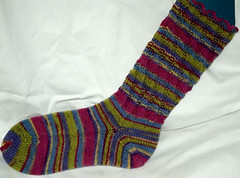
I like hand knit socks. I started knitting socks a few years ago and discovered with the first pair--knit of Patons Classic Merino--that hand knit socks are basically little sweaters for feet. As I have perennially cold extremities (hence the affectionate nickname "Popsicle Toes"), hand knit wool socks are a luxury.
Because I make my own socks, I get to choose my own yarns. I began with some basic, moderately subdued colors, but quickly moved on to the more "interesting" colorways. Opal, Blue Moon, Flat Feet, Red Heart--I like them all, as long as they're moderately to very bright and bold. I knit my socks toes up, one at a time, from a "figure 8" cast-on to an "afterthought" heel: only the leg changes, as I get bored with just plain ribs (the sock above has a spiral rib leg).
I ordered a couple skeins of the yarn, and was impressed by how similar they are to the scarf colors--the photo at the right is the skein, sitting on a portion of my new Scarf, currently underway. The only missing color was the olive green, so I ordered a skein of KnitPicks Essentials in the Sarge colorway to add in some green.The plan is to knit this pair of stockings as a 4x1 rib. As I knit socks from the toe up, I started with the Sarge Essentials and knit the toe, then switched to the Felici Time Traveler. At round 65, I knit half of the round with a bit of waste yarn--I will go back later and knit an "afterthought" heel in the Sarge colorway--then continued on up the leg in the 4x1 rib. When I get the leg long enough to reach my knee, I'll switch back to the Sarge and knit a turn-over cuff before starting on the second stocking.
This pair of stockings is fun to knit--the yarns a buttery soft, and the pattern is just complex enough to keep my interest. At the end, I'll have another pair of very loud knee socks to wear with some of my outfits.
Tuesday, May 25, 2010
The first step in costuming does not involve fabric, pins, a sewing machine, or an iron. It does involve, in my case, paper, pencils (both regular and colored), an eraser, india ink, and a moderate amount of swearing. This is a brain dump, where my ideas are taken out of my head and captured on paper. For me, it's an important step because without it, I'm relying on an overly full memory to keep track of all the details of an outfit. Putting it down on paper solidifies the idea and makes it a bit more real; I also can start to think about what materials I will need to turn the drawing into reality.
Some time this past weekend was devoted to a brain dumping session. I need several new outfits, along with new underpinnings. There's too much--about 25 pieces--to just work from a list, so some sketches are necessary. I also want to try out some trim details before committing to one specific idea, and sketches are the least expensive route.
So, what am I considering? Nothing short of a nearly complete wardrobe for a lady archaeologist/cultural xenologist in 1905. No big puffy sleeves and giant hats full of dead birds: these are practical clothes that can take me from the field to the lecture hall in style and comfort. The list:
Underpinnings:
2 chemises, both trimmed with hand-crocheted lace (more on that later)
2 prs. French drawers
1 petticoat
1 Equipoise basque (basically an unboned corset)
2 prs. loud handknitted stockings
1 pr. black lace handknitted stockings
Field dress:
1 white shirtwaist
1 split skirt
1 Norfolk jacket
1 topee with veiling
1 pr. stout walking boots
1 tie
Lecture/Meeting dress:
1 white shirtwaist (see above)
1 gray tweed vest
1 navy Eton jacket with white braid trim
1 navy walking skirt
1 straw boater,
1 pr. sensible shoes
1 tie (see above)
Cycling outfit:
1 sky blue shirtwaist
1 gray tweed vest (see above)
1 pr. navy bloomers
1 gray tweed Norfolk or Reefer jacket
1 straw boater (see above)
1 pr. black gaiters
1 pr. low-heeled boots
1 tie (see above)
It's a lot of cutting and sewing, but I really need to build a lot of new clothes; it's been 15 years since I last built a wardrobe for this time period, and my figure has changed somewhat in the intervening years. One piece at a time, I will build a new wardrobe.
Monday, May 24, 2010
After an extended hiatus, I'm preparing to drag the sewing machine out and build myself some new clothes. Not clothes that I would normally wear to work--clothes that I wear to play, since my idea of "play" still includes a good amount of "dress up." This summer I am doing some serious costume-building.
If one were to diagram my friends and my play, it would be a Venn diagram with three very overlapping circles. Some of my fiber friends are also fans of the British TV show Doctor Who; others are in the historical reenacting and fiber circles; a few are in all three. Now there's a fourth circle: steampunk.
Steampunk--as a literary form--is a subgenre of science fiction extrapolating the idea that Charles Babbage's Difference Engine (now considered to be the world's first computer) was built and the design improved upon in the 19th Century. It's a world populated with technology that operates with steam and gears, and a rather Victorian sense of geopolitics: the United States is split into several different countries, depending on the author, and the sun has not set on the British empire. An excellent description of the origins of steampunk can be found in Jess Nevin's essay, "The 19th Century Roots of Steampunk," in Steampunk. Steampunk has taken the historical costuming world by storm.
Steampunk as a venue for costuming is fun, because it draws heavily on 19th and early 20th Century clothing (approximately 1850-1910). It gives me a reason to revamp my wardrobe after a long break from this period, with clothes I can wear for action-shooting, historical reenactments, the odd science fiction convention, and of course steampunk events. As an early 20th Century technical exposition--The Great Pan-kinetic Exposition--is tentatively scheduled to be held sometime in 2011, I have no excuse to not start building clothes appropriate for it and other events.
So this is the start of an actual dress journal. Stay tuned, and follow how I go about refurbishing my wardrobe.
Wednesday, May 12, 2010

Don't Teach Your Grandmother to Suck Eggs
For years I've heard (accompanied by a long-suffering sigh): "Everybody and their mother gets a camera and immediately thinks they're a photographer." This statement comes from a darned fine photographer with decades (four, to be exact) of experience; he's commenting on the difference between the amateur snapshots that many people--including me--take and the carefully composed photographs that capture what he sees for the rest of the world to share. The guy is good, really good, and over the years I've watched him patiently put up with the n00bs who--with exactly 15 minutes of experience with a camera--tell him exactly how to go about capturing a moment.
I'm suddenly running into fiber version of the n00b with the camera. As I start to shift from the winter months full of papers to write, papers to grade, and the workload of both graduate school and full-time teaching, I'm starting to monitor the fiber-related social networks. During the eight months I've been away, focusing on Real Life, a new crop of n00bs has grown up, most having received fiber equipment (usually spinning wheels and/or looms) while I've been away. Many are true n00bs, full of eager questions and excited to share their new successes at an art form. It's fun to watch their excitement, give them a bit of support, and occasionally give them a gentle nudge down the path to all things fibery.
Unfortunately, along with all these excited fiber "puppies" come the fiber "n00b with a camera." We've all run into her/him: he/she is the person who has just gotten a spinning wheel, has read one or two books on how to do a specific aspect of fiber (e.g., spinning), and are now the complete expert on spinning. She/he loves to share their knowledge with everyone, whether or not asked, and is double-quick to tell people they are wrong when confronted with information different than the book(s) he/she has read. I've also noticed that the "n00b with a wheel" is also very young; in many cases, I started working with fiber long before the n00b was born.
So, to all the n00bs with a [fill in the blank]:
- I learned to crochet at my mother's knee in 1961, and learned to sew and knit when I was a Junior Girl Scout, around 1966 (my Sewing Badge was my second badge, right after Housekeeping). I started weaving potholders in 1965, and did my first weaving on a floor loom in 1967. I took sewing and needlework classes in high school, and by the time I graduated I was skilled at most types of needlework and could sew my own clothes. By comparison, spinning is a recently acquired skill--I've been spinning since 1994.
- Unlike you, I haven't gleaned all my knowledge from one or two books. I've had the tremendous opportunity learn under the guidance of some of the foremost teachers in the United States. I don't like namedropping: open a copy of Handwoven or Spin Off to the contents page, and chances are good that at least one of the authors each month is someone I've taken a workshop from. Workshops aren't the only way I work to improve my craft. I've got "a few" (roughly 300) books on fiber and needle arts.
- In the nearly 50 years I've worked with fiber, I've learned one universal rule: there are at least two ways to do nearly anything connected with fiber. Some things don't work quite as well as other things, and sometimes a different technique is required for each different type of equipment. Whatever works best at the time with specific equipment and specific fiber is the best technique. It's knowing which technique works best in each circumstance that separates fiber artists from fiber hobbyists, just as it separates photographers from snapshot takers; refusing to consider other techniques merely makes you look small-minded and becomes an obstacle in your own path to knowledge.
- There's an old saying, "Don't try to teach your grandmother to suck eggs." In other words, don't give advice to someone with more experience than yourself.
The photo at above is the Aurora Borealis shawl, knit from some nice Mountain Colors Targhee (colorway Northern Lights) that I spun as a fingering-weight 2-ply a while back.
Thursday, April 22, 2010
Spring is making a valiant attempt at appearing in Northern California. Valiant, but not terribly successful yet: the fancy irises are starting to bloom, but we still get cold, rainy days (yesterday's high was 58 degrees).
No matter. The days are getting longer, and I'm starting to feel a touch of Spring Fever. It's the same every year; we approach the end of the school year (only 33 school days left!) and I want to spend more time at play in the studio. Due to other commitments (that Master's thesis), finding the time to play is difficult, but I'm trying to carve out bits of time to spin, knit, dye, or just tidy up the studio. I need a bit of balance; too much school and I crack under the stress, so the art is a good release from the stress. I've managed to get a few things done; since the first of the year, I've knit 2 shawls, a scarf, and another pair of socks. I've dyed half of the yarn I scored at the White Elephant Sale in January a beautiful shade of blue-purple. I've designed and started knitting another large lace shawl using the above-mentioned dyed yarn. Last weekend I picked up my combs for the first time in 8 months and got most of another color (red) combed and ready to spin. I finished spinning and plying the blue warp.
I'm also trying to carve out a bit of time for the blog. I'm a rabid microblogger on Plurk, but writing proper blog entries takes time, but time is in short supply. That should change soon (Did I mention there are only 33 school days left?), and I should have more time for the blog. One new change: I updated my photo. The old photo was about 10 years old. The new photo was taken in late January, right after I had about 15 inches whacked off my hair (it was well past my waist).
Friday, January 15, 2010
I've been watching the nearly non-stop coverage of the disaster in Haiti's capital of Port au Prince.
Under the best of circumstances, in a place where we expect earthquakes as one of the prices we pay for living in "the best place on earth," an earthquake is a horrible, terrifying thing. I should know; I went through the Sylmar earthquake (6.6 on the Richter Scale) on February 9, 1971, and it took me years to get over that event. However, everything got rebuilt, in many cases stronger/more earthquake resistant, and I've managed to miss all the other big earthquakes--I was in Southern California when Loma Prieta happened in 1989, and I was living in the Bay Area when the 1994 Northridge Earthquake (16 years ago Sunday) occurred. Even then, it was more inconvenience than actual hardship. Yes, the electricity was spotty. Yes, it was frightening when the aftershocks happened. But we had running water, plenty of food, and we got through it.
The people of Haiti, on the best day, don't have all the advantages of living in a wealthy country, much less the richest country in the world. Eighty percent of Haiti--the second-oldest independent country in the Western Hemisphere and the only country in the Western Hemisphere to kick Emperor Napoleon's butt--lives below the poverty line, and 78% of Haitians live on less than $2/day. The last time a major earthquake hit Haiti, it was a plantation-filled colony of the French, and the US was just beginning to talk about how King George II was abusing his American colonies. Haiti is a land completely unprepared for a major earthquake, which hit on Tuesday afternoon.
It's bad. It's really bad, and this was only a 7.0--the same magnitude that could so easily occur on the many faults that cross the San Francisco Bay Area like lacework. The earthquake that struck Haiti could have so easily struck San Francisco or the East Bay, destroying homes, schools, and lives. The estimates are (at 7:00 pm PST) that 150,000-200,000 people lost their lives, and that nearly 3 million people are hurt, homeless, and hungry. For a country that has only a population of 9 million, that's a lot of suffering.
We are a wonderful group of people. We argue, we fight, but when somebody is suffering, we step up and become the most wonderful, generous people around. I've seen this happen time after time after time after time. We open our hearts, our homes, and our wallets, no matter how thin, to help those who have even less and are suffering. And right now, the people of Haiti are suffering.
So, how can we help? Right now, the biggest need is for money. Plain old American dollars. Dollars buy the medical supplies to suture cuts, set broken bones, stop the pain. Dollars buy bottled water, food, and tents to provide shelter. Dollars help organizations such as Doctors Without Borders, Save the Children, and the International Red Cross to get aid to where it's needed. I've put a bunch of links to different relief organizations at the end of this post. In some cases, it's as easy as sending a text message. I don't normally do this, but please give what you can, because there, but for the grace of God, could be any of us.
Haitian Earthquake Relief
American Red Cross Haitian Earthquake Relief
--Make a $10 donation by texting HAITI to 90999
The Clinton Foundation
--Make a $10 donation by texting HAITI to 20222
Compassion International
--Make a $5 donation by texting DISASTER to 90999
International Rescue Committee
--Make a $5 donation by texting HAITI to 25383
Salvation Army
--Make a $10 donation by texting HAITI to 52000
The United Nations Foundation
--Make a $5 donation by texting CERF to 90999
The United Way
--Make a $5 donation by texting HAITI to 864833
Yele Foundation
--Make a $5 donation by texting YELE to 501501
Thursday, December 31, 2009

Grrl @ Work
Once again, I've disappeared from the blogosphere for an extended period of time. My disappearance can be summed up in two words:
Graduate School
In mid-August, I was offered the opportunity to finish up a Master of Arts in Educational Technology (the geeky part of education) at Touro University. Finish up this part of my education at a site a few minutes from home, and for less than what the local public universities were charging? I jumped at the chance, even though the course load was going to be heavy (cramming six semester classes into two semesters, rather than the recommended three), and I was teaching two new courses at the high school. It's been a semester full of tight deadlines, missed research opportunities (it took Touro nearly six weeks to grant me access to their library and online research tools), a few sleepless nights, and stress, but the semester finished on December 18 with everything turned in on time to good reviews by my professors and peers. I'll dive back in after the start of the new year, but right now I'm enjoying a too-short break for the holidays.
My refuge from the stress of school (teaching) and school (attending) has been fiber. I haven't been able to get very much spinning done in the past few months, and the stair runner is still on the loom, gently mocking me for starting a project I wasn't able to finish before my schedule filled up. Instead, I've been knitting. I normally knit as a way to stay focused at meetings, but 2009 is a year when I've turned out a large number of small projects. I've tracked them this year by entering each into my Ravelry notebook, and tagged each with "2009fos." Since this is the last day of 2009, it's now time to list what I've finished:
Weaving:
- 10 bookmarks (which I'm finding very useful)
- 2 1817 Student Socks, 1 in sock yarn, 1 in DK, to test the pattern
- 1 Bachelor Tea Cozy, from a pattern in Weldon's
- 1 Cowl of black baby Alpaca
- 1 Calorimetry shaped headband out of purple Alpaca
- 1 pair of Brioche stitch wristwarmers
- 1 scarf in an old Shetland lace pattern (Razor Clam?) out of fuschia Angora blend
- 1 Chevron Lace Beret out of the same DK as one of the 1817 Student Socks
- 1 tiny coiled basket out of some of my handspun
- 1 Irish Hiking Scarf out of peacock wool
- 1 scarf based on the Irish Hiking Scarf with additional baby cables out of purple wool
- 1 beret based on the formula published by Ida Riley Duncan out of purple wool
- 1 pair of Irish Hiking Wristwarmers out of purple wool
- 1 pair of children's mittens out of red variegated wool
- 1 pair of socks out of Opal
- 2 pairs of socks out of Red Heart's "Heart & Sole" sock yarn
- 1 pair of slippers out of some old stash wool
- 1 scarf in Feather & Fan lace out of dark brown variegated wool
Monday, July 27, 2009
It's been one of those days when it seems that the entire world is now populated with people that haven't the vaguest idea of what they're talking about. I normally go through life nearly oblivious to these well-meaning souls, usually with nothing more than a slightly pained smile and that most useful of comments, "Well, bless their hearts..." Usually these poor benighted beings avoid me like a form of plague--I can be intimidating under most circumstances, and downright forbidding if I haven't had any coffee. However, the moon must be in just that phase when they all decide it's time to come out of the woodwork--or wherever else they H.L. Mencken once said, "Those who can--do. Those who can't--teach." I think it's time to update that old saw to: "Those who can--do; those who can't--complain interminably on social networking sites." The past 24 hours has been filled with comments by people complaining that they can't: a) travel where they wish; b) have the fiber they wish; or c) do a type of fiber art. An example: someone complains vociferously about how difficult/tiring/time-consuming it is to comb locks with mini-combs. Other posters join in, commiserating on how simply awful it is to use tiny combs to comb ten pounds of fleece. Finally, your intrepid blogger does what needs to be done: gently suggests that it might be best to use big bad English combs for combing the fleece, as that's what they were designed to do. At this point, the excuses begin. English combs are expensive; they are, but so is a spinning wheel, a drum carder, and we aren't even going to talk about the price of a new floor loom. English combs are dangerous, with all those long, sharp tines; so is a 10" French chef knife, and I don't hear anyone complaining about using one of those. English combs are too big and hurt my hands; have you considered doing some hand/wrist exercises? What is not being said: I'd rather use the wrong tools, spend time complaining to others, and then blame my less than satisfactory results on the tools. Poor tools--they were only doing what they were designed to do.
I'm also being plagued by the "ukants": people who say, "You can't do that." "Can't" is a word rarely found in my general vocabulary. There are very few things I can't do; as my dear mother frequently says, "I could probably do brain surgery, given the right training and tools," and I've usually followed that same philosophy. When someone says "can't," if they're lucky, they'll get "The Look"--that sideways over-the-glasses look that teachers give students who are about to do something stupid/wrong/illegal. If they aren't lucky, they may be treated to a "gentle" explanation--in excrutiating detail--of exactly how I will go about doing just what they said I couldn't do, followed up by my giving them several suggestions on what they can do (jump in a lake, kiss a pig, you get the idea).
The latest target of the ukants is my good old Gilmore loom. It's big, it's heavy, it's old, it's noisy, and it weaves like nobody's business. A lot of thread has passed over the warp and breast beams of that loom (it's not dated, but the consensus is that it's from around 1940) in the last 69 years, and it's still going strong. You can imagine my surprise when I was informed that my loom was all wrong--the shafts are too low and there's no way it could possibly make a shed for weaving a rug. Huh? I've woven rugs on it for years--it weaves very nice rugs. Oh no, say the ukants, you have to get a big Swedish loom with a big overhead beater that makes giant sheds to properly weave rugs. Huh? I don't have the room for a big Swedish loom with a big overhead beater, and why do I need a gigantic shed anyway? I weave rugs with ski shuttles that are 1 1/4 inches tall--I need 3 inches, max.I suspect that some of this pushing back against the ukants (besides being naturally obstinate) is that I didn't learn to weave in a formal setting. I learned to weave the way I learned to knit, to crochet, to sew, to cook, and to make terrific jams and jellies: by learning at the knee of another, asking questions when I didn't understand, and supplementing with a lot of reading. Older weavers, some of whom had been weaving when my loom was new, were patient and generous with their time and knowledge, and answered a child's endless questions on the whys and hows of weaving. It turns out, I have an affinity for the loom and its workings: I can't explain how I know when a warp is tensioned properly, or why I rarely use a temple and still have nearly perfect selvages any more than I can explain how I know when a conserve is cooked enough and is ready for the jars. The knowledge is in my hands and fingers. The ukants, trained in their formal textile labs and classrooms to always do "this" and never do "that," don't grasp that there are others for whom "that" is just what they need to do. For the ukants, the loom is a noisy piece of equipment; for some of us, it's the music of a centuries-old song of labor and love and beauty.
Sunday, July 05, 2009
When I got the Romney home, the first order of business was to get the locks separated and into nylon netting for washing and dyeing. I'm a firm believer that nylon netting is the most useful fiber prep tool around, because it gives one the ability to both wash and dye locks with a minimum of fuss. The only downside to using nylon netting is the time involved in laying out the locks (tips all going the same way), and wrapping them in the netting. It's not a quick process, especially as I take the time to pick out any second cuts or large pieces of VM. However, I just put on my iPod and get to work, laying out locks, and once three layers of locks were in place, stitching the bags closed. It took the better part of two days to prep the entire 3.87-pound fleece.
Once that was done, it was time to wash. I washed in my usual way (for information on how to do this, see this blog post), but with one difference: rather than rolling each bag into a roll, I found they got cleaner if I simply folded them in half and pinned them to the top of the laundry bag. With three per bag, I had everything enclosed in three laundry bags. Once washed, dried, and weighed, I put the nylon net bags of locks into a large pot of water to stay wet until I was ready to dye them.
Dyeing the locks was also a pretty straight-forward process, once I determined the formulas for the colors I wanted. Most of the colors were plain Jacquard acid dyes, twice the weight of the locks I was dyeing. Two colors needed some "tweaking:" Purple, which ended up a 50/50 mixture of Violet and Lilac, and Green, a 50/50 mixture of the old Robin & Russ Handweavers Dye in Hunter Green and Jacquard's Chartreuse. Dyeing went well, except for the Green: for some reason, the Robin & Russ dye didn't strike (penetrate the fiber), and the locks came out too light. Those will have to revisit the dye pot in the next few days. However, all the other colors came out well.
Next: Combing the locks.
Thursday, June 25, 2009

Weave Journal #1: Worms
We need a new runner on the stairs. The current runner is one of those "buy it by the foot" nylon pseudo-Chinese carpeting that used to be sold at home improvement centers, and was in place when we bought the house in early 1994. I think the runner may date from when the house was remodeled, in 1981. It's "woven" in shades of mauve and tan, and after 15-28 years of service, it's looking pretty shabby.
I am perfectly capable of weaving a rug. I've done it before, I have the equipment--a good loom with a heavy beater--and I have the time this summer to complete the project. This is a perfect opportunity to weave a rug with Pendleton "worms."
Pendleton Woolen Mill makes some of the nicest wool fabrics and blankets around. I have one of their "Glacier National Park" (aka "candy stripe") blankets, and it's the blanket that I sleep under whenever I go camping. The process for making these blankets is pretty straightforward, and they're finished with a neat serged binding. As part of this binding process, 1/4" to 1/2" of each side of the blanket is trimmed off, making these long strips known as "worms." Pendleton figured out pretty quickly that people were buying the trimmings for weaving rag rugs, so they box them up and sell them, 50 cents a pound plus shipping to wherever you are. I called them on Tuesday morning and ordered a 25-pound box of worms. Our friendly UPS man lugged a huge box up the stairs and dropped it on our porch this afternoon. I had my worms.
Getting the worms was just the first step. Pendleton doesn't make just blankets; they make a variety of different types and weights of woolen fabrics. An order of worms contains everything from the trimmings pile, so the worms have to be separated by weight and color. Fortunately, it's not difficult, as the worms are not thoroughly mixed together, but it is time-consuming to empty a 25-pound box and bag up the separated contents. My box was about 1/3 trimmings from the lightweight blanket fabrics in cream, taupe, and chocolate brown, about 1/3 trimmings from the unfulled wool/cotton blankets, and about 1/3 trimmings from their legendary National Park blankets. I sorted everything, and it appears I may have enough of the heavy trimmings for at least one of the stair runners (there are two--above the landing and below the landing). The cream, taupe, and brown worms will go into various dyepots and will become another rug.
Wednesday, June 24, 2009

...Three Bags Full
The big reason to travel to Eugene every June for the Black Sheep Gathering is to partake of the great Wool Show and Sale. This year, I missed the judging, as I was either in class (Friday) or frantically shopping in between classes (Saturday morning). This year's judging was done by Mark Eidman, and from what his clerk staff has reported, it was tough--this year's fleeces were exceptionally fine.
People were also in a mood to buy. Every year, there is a room off the main Wool Show space for Class 00--For Sale Only fleeces. It can be a good place to pick up a decent fleece for a bargain price, as these fleeces are not part of the regular Wool Show and aren't judged. I trotted across the parking lot on Friday afternoon to check on what was in the Sale Room. I expected to find a good number (50 or so) fleeces; I found a lot of nearly empty tables and half a dozen marginal fleeces. When I asked the exhausted-looking women "manning" the Sale Room, they told me it had been like a scene from the Oklahoma land rush: 100+ fleeces sold in less than 6 hours.
I knew I had one fleece--the incomparable BLX, waiting patiently for me to pick it up. Thank heavens I had been able to secure it before the show! I met up with Liz Hubbard of Hub Corriedales and picked up my lovely baby. This year's fleece rivals last year in length and crimp; only the weight is less (6 pounds instead of 10+ pounds). I lugged the box back to camp and locked it in the car--nobody was going to get my precious!
However, one fleece was not going to be enough. I really wanted a charcoal gray fine wool fleece, and since the Sale Room was empty, I was going to have to pin my hopes on the Wool Sale itself. When the viewing time came on Saturday afternoon, I started looking for good charcoal gray fleeces. I found one, started to examine it, when someone said, "You seem to have picked up an entourage." Sure enough, people were starting to follow me around to see which fleeces I was selecting. I actually had to bare my teeth and snarl, "This isn't a field trip--go away!" I wandered away, and once I knew I was alone again, I "casually" found exactly what I was looking for--a glorious dark charcoal merino fleece from Nebo-Rock Ranch, with a blue ribbon on top of the fleece in the bag. Once outside waiting for the sale to begin, I explained to my "runner" that she needed to quickly walk over to that fleece while I walked over to my second choice; if I saw that she had gotten it, I would come over to her to claim that fleece. Our plan worked like clockwork, and within a few minutes of the start of the sale, I had my fleece.
Sometime the right fleece for a project simply pops up. I was satisfied with both my fleeces, and was starting to think about what I could do with them, and with the other fleeces I'm still working my way through. I have a particularly nice black Romney from Ace in the Hole Ranch that I bought at Lambtown in 2007; it's washed, and I've been slowly combing and spinning it. Early Sunday morning (at 4:15 a.m. to be exact), I had an epiphany and knew what I needed to do with that fleece--weave a ruanna. However, I needed a small, good, white Romney fleece to dye for warp. Sunday morning I trotted back over to the Wool Sale (and got caught in a rain shower), thinking that if I found a small, good, white Romney for a good price, I'd have my warp. Romney sheep are not small animals and they do not produce small fleeces--8-10 pounds is more normal for them. However, I found a lovely bright-white Romney fleece that hadn't placed because it was "too small" (3.87 pounds). Perfect! It was less than $35. Even better! I had my small, good, white Romney at a good price.
Tuesday, June 23, 2009
June rolls around and two things happen: school finishes for the year, and the entire fiber-related community (that matters) makes the pilgrimage to Eugene to spend three days ogling fleece, rovings, tops, yarns, dyes, and loads of spinning equipment. It's time for the annual Black Sheep Gathering!
This year, I drove. Normally, I take the train. It's simple: get on the train in Martinez at 11:00 on Wednesday night, wake up near Mount Shasta on Thursday morning, have breakfast and lunch on the train, attempt to take over the lounge car with spinners and knitters, and generally have a good time before arriving in Eugene around 1:00 in the afternoon. Then, it's just drag the gear out to the fairgrounds and get camp set up. However, I really wanted to try making the drive, both because I can take a bunch of extra stuff, and because this year both Betsy and Jane were going to go along with me. If three go, the costs of driving up there, getting a hotel room, and eating out should still be cheaper than traveling by train, right?
I will not miss Black Sheep, barring something truly serious (e.g., major hospitalization), so when Betsy called on Tuesday around lunchtime to say she finally heard from the company she's been trying to get an interview with and she couldn't go, I started to shift gears to take my own car and just Jane and I going up there. No problem, I can handle this, I just need to finish cleaning the disgustingly dirty house so it's fairly reasonable when Jane gets here to spend the night before leaving.
At 6:30 p.m., the 100-year-old plumbing in the upstairs bathroom finally gasped its last and sprung a leak. Fortunately, it's a leak in the drain portion, so I didn't have water squirting everywhere, but I had water pouring onto the floor every time I turned on the shower...and it was past the time I could call the plumber. I am still going to Black Sheep--plumbing or no plumbing. I called Jane and let her know the plumbing situation ("Shower at home--the dodgy bathroom plumbing has gone sideways and we're not sticking around waiting for a plumber tomorrow."), grab some towels and the world's fastest shower (<60 style="font-weight: bold;">Rain Sounds Like Popcorn on a Nylon Tent
Friday, May 29, 2009
Chained to the Sewing MachineAfter a very long time, I am willingly "chained to the sewing machine," finishing clothes to wear to the Pacific Primitive Rendezvous. After several years, the organizers of the rendezvous have very kindly decided to hold the event in Northern California, about three hours from home. Since they've been so considerate, I'm returning the favor by attending this year.
For those unfamiliar with rendezvous and other Fur Trade Era fun, a rendezvous is a late-18th/early-19th century historical event that attempts to recreate the big rendezvous of the Fur Trade Era (1831-1842). These events included shooting events, a lot of shopping (the purpose was to sell the pelts collected and buy supplies for the upcoming year), and a great deal of drinking and swapping lies. The present-day rendezvous continue in that tradition. The Pacific Primitive runs for about 7 days, and I'm planning on attending the first 3 days before returning home, repacking the car, and traveling up to Eugene (Oregon) for this year's Black Sheep Gathering.
I haven't been to a rendezvous in 15 years. I haven't even done very much reenacting in the past few years. As a result, I need clothes. Since the clothes I need aren't exactly something that comes off the rack at Kohl's, I have to make them myself. This isn't difficult--I've been sewing for more than 40 years--but does require some organization, always a tough thing at this time of year. I need two new skirts and probably new underpinnings, so I have some work to do.
The skirts are important (I can't run around without a skirt--it simply isn't done), so they're first on the list. I have some hand-dyed green linen for one skirt, but I need some red fabric for a second skirt. Fortunately, Hancock's had 5 yards of perfect dark cherry-red cotton and I had a 50% off coupon. Score one skirt! I hustled back home with my booty and washed it while I excavated the sewing room.
The problem with not sewing on a regular basis is that the sewing room becomes a place to store things I really should put away. I stacked things in there when we painted the studio in March, and now it was time to get them out of there. After several hours, I had a functioning sewing room again, the ironing board was set up, and I was ready to start knocking out skirts.
The skirts are classic Californio skirts: 3 tiers of gathers, simple waistband. I tore the linen into strips the width I needed, sewed the tiers, and gathered them. Ugh--gathering that much fabric (the bottom hem is about 150 inches) is a pain! However, I finally got everything gathered and sewn together before I called it a night. The next morning, I tackled the second skirt. I wasn't looking forward to repeating the gathering, and remembered that I had a ruffler for one of my sewing machines. The problem? Figuring out which machine it worked with. My Viking was ruled out pretty quickly, as was the Pfaff 230. I thought it might fit on the old White Dressmaker, but it didn't. Becoming desperate, I moved everything off the cabinet of my tried and true Kenmore, and tried the ruffler on it. Success! I ruffled the strips and sewed the second skirt in a few hours.
I handsew my hems and waistbands. I don't need to--I have a machine that does beautiful machine-sewn hems--but every time I do, I can hear my mother saying, "It would look better if you did that by hand." OK, Mom--I'll do it by hand. Handsewing hems in these skirts is time-consuming, but not tedious. I have a lot of British TV on the computer in the studio, so I just clamped my sewing bird onto my work table and sewed the hems and waistbands while watching episodes of Doctor Who and Torchwood. The skirts just need buttonholes in the waistbands and buttons sewn on, and they're finished.
It's been surprisingly pleasant to sew costumes again, so I've begun planning the next big ensemble: a 1880s (2nd Bustle) walking outfit, out of striped cotton upholstery fabric and brick red cotton velvet. The goal is to get it finished (along with a complete set of new underpinnings) in time to wear it to the Great Dickens Christmas Fair in December. If I start it this summer, I just might have it finished in time!
Thursday, May 14, 2009
Fomenting WeavolutionNine months ago, a small group of women decided that the fiberarts world needed a social networking site. Ravelry, created in April, 2007, was growing by leaps and bounds (350,000+ members as of this date), but Ravelry was designed for knitters and crocheters, not weavers and spinners. In spite of gentle noodging by Ravelers that spin and weave, the site couldn't do certain things, such as accommodate weaving drafts or catalog the mountains of fiber, thread, and yarn spinners and weavers quickly attract. Tien, Claudia, and Allison, weavers all, began work on the site, which is now--after eight months of raising money and design work--nearly ready to launch.
A few weeks ago, Tien put out the call for people to start helping get the site ready for the world. The technical end was almost completed: it was time to debug and load content (a fancy tech word for "data") before asking
The best way to clean up and prep a site for launch is to "divide and conquer": everybody takes on a portion of the site as their responsibility, and starts making notes on what is broken, what needs tweaking, and what content is needed to make the site attractive to users. I snagged
- Looms and their manufacturers
- Groups
- Forums
Weaving is a task that requires technology, even if that technology might appear to be nothing more than a bundle of sticks and strings, or something so small you can hold it in the palm of your hand. One of the features built into the site is the ability to catalog looms owned by a weaver, so all the information they need, such as the type of loom, who built it, and its size, is at one's fingertips. Weavers need this feature because we don't have just one loom: we collect equipment and tools the way a knitter collects knitting needles. An inventory of my own collection of looms revealed
- 1 floor loom (my beloved Gilmore X-frame)
- 2 inkle looms (1 floor, 1 lap)
- 1 Navajo loom
- 1 tapestry loom
- 6 frame looms (2x2, 4x4, 2x4, (2) 4x6, 12x16)
So, inventories are necessary, but to build inventories, you need data--lots of data--on the looms and their manufacturers. I didn't realize until I started on this project how many companies manufactured looms during the 19th and 20th centuries. There are currently about two dozen loom manufacturers, ranging from tiny handheld portable looms to big industrial-sized looms. That's not too bad, and I gathered all the contact information in a couple hours. The real job began when I started to list the looms made by companies no longer in business. There were scores of loom manufacturers, most of them very tiny, that produced looms for farms and small weaving shops between 1880 and World War II and beyond. Many of these looms are still in use in homes, studios, and schools today, and will eventually end up in someone's inventory on Weavolution. I've put out the call for information on most of the weaving-related listservs, and I'm getting a lot of names; now I have to dig for more information, and load all this data in before the site moves to Alpha testing on Saturday.