Showing posts with label Rendezvous. Show all posts

Sunday, July 19, 2015

Back to the Salt Mines

Mongo with the old 1-yard sectional warp beam.
   After a hiatus of several months, I'm once again throwing a shuttle. There was a good reason for not weaving: I "broke" my loom.
   When I bought Mongo, my big 16-shaft Macomber, it came with two plain warp beams. Now, having two warp beams is nice, but having a sectional warp beam is even better, especially for the long warps I normally weave. I bought a used (well-used, it turned out) 1-yard sectional warp beam, just after we brought Mongo home, installed the sectional warp beam (removing both plain warp beams in the process), and got to work. It was a pretty good warp beam, considering that it was probably older than I am, and I run quite a bit of warp through it during the nearly two years it was on the loom.
   Unfortunately, in early April, like the wonderful one-hoss shay, it finally fell into pieces...about four yards before the end of a warp. My only indications that it was failing were the metallic sounds of the steel section pins hitting the floor. As it occasionally shed pins in the past, I didn't worry until I found that every time I pulled the beater toward me, the entire beam would lurch and advance. Not good. I ended up jury-rigging a couple of weights to counteract the pull of tensioning, and wove off the warp, getting up to removing the weights, advancing the warp, then weighting the beam again. It was a struggle, but I finished the warp, cut off the cloth, then surveyed the damage. Most of the steel section pins were on the floor behind the loom, and the wood friction brake drum was as smooth as a piece of glass. My big sectional warp beam was done.
   One of the great advantages of owning a loom that is still in production: I called Macomber to order a brand-new warp beam. Large pieces for a loom tend to be semi-custom orders, I could pick and choose exactly what I wanted--the smaller, 3/4-yard sectional, with a steel friction brake. Ed (the owner of Macomber Looms) said it wasn't any problem, but he was waiting on his foundry to produce "spiders"--the steel spindle at the opposite end of the beam. He thought he'd have them in by the end of the following week, and he would call me.
Mongo, with the new sectional warp
beam and one of theold plain beams.
   The "following week" turned out to be six weeks later. Occasionally, that's the problem with fiber arts equipment. Nearly all the manufacturers are very small businesses, and their vendors push them to the bottom of the list of work orders because their orders tend to be very small.
   About 10 days after Ed got the spiders, the UPS man dragged a very large crate onto my front porch: I had my new warp beam. We carefully unpacked it, carried it upstairs, and I reconfigured the back of Mongo into exactly the configuration I've always wanted: sectional warp beam (the beam I use the most) on top, controlled by the friction brake, with the plain, ratchet-brake beam on the bottom for when I weave with supplemental warps. I also adjusted the brake so a slight tap releases the friction brake, but pushing it all the way down releases both beams to advance both warps together. All in all, it's a pretty slick set-up.
   With all the preparations and travel in June, I didn't have the opportunity to dress Mongo until the beginning of July, but when I did, I put on 18 yards of natural 8/2 cotton to weave the linsey-woolsey I've been promising myself for the past year. I spun the weft from a Nebo-Rock merino hogget in 2013, and dyed half of the yarn with indigo and the other half with marigolds last summer, specifically for this cloth. The striped indigo was the first piece, and I ended up with nearly 8 yards on the loom. Right now, I'm weaving off the plain yellow cloth. Once wet-finished, the striped will be turned into a late 18th-century short gown, with a petticoat/skirt from the yellow.
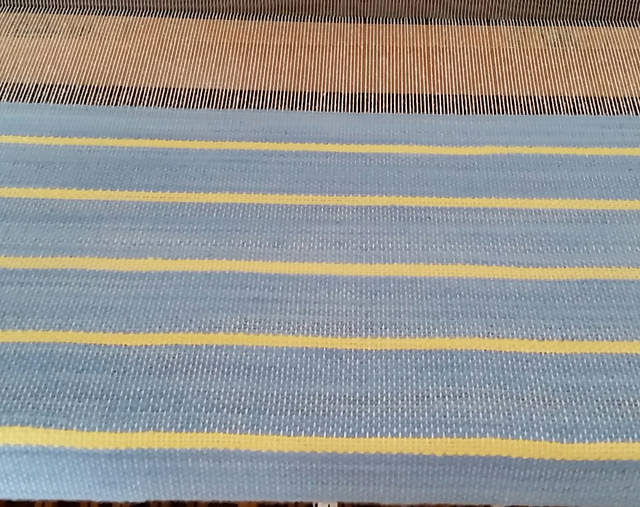
My marigold-striped indigo linsey-woolsey. 

Sunday, June 14, 2015

Packing for Time Travel

   Every time I pack for a trip, I feel like I'm coordinating the invasion of a small country--there is so much stuff I have to drag along with me! A lot of my trips involve camping, so there's all the camping gear--tentage, bedding, cookware, an ice chest or two, food--along with some clothes, and the all-important "stuff" to keep me happy and entertained while I'm in the Great Outdoors. This means at least one spinning wheel, bobbins, a kate, a niddy-noddy, and fiber, along with some needlework project (usually knitting) to work on in the evenings or when I don't feel like spinning. The stuff for a camping trip fills the entire back of my CRV; an extended trip means I have to take some things out (or put them up on the roof in the carrier) just to have room for an additional passenger.
   A "period" camping trip is a bit more problematic: all my gear, clothing, and food have to be as close to the time period as possible. I refuse to be "That Person" (the one who knows better, but doesn't bother), so "time travel" can take days or weeks of preparation.
This year's rendezvous site, on the
Chewaucan River in Oregon.
   I'm in the throes of packing for the 2015 Pacific Primitive Rendezvous, and it's a logistical challenge. First, there's the camping gear: when I go to a modern camping event (such as the Black Sheep Gathering), my tent, canopy, sleeping bag, air mattress, pillows, and blanket take up a space about 3x3x3'. When we (I normally travel with the Spousal Unit) go to a rendezvous, our 12x20-foot canvas bell tent takes up that much space, with additional space needed for the fly, the tent poles, the ropes, and the tent stakes. The Spousal Unit refuses to sleep on the ground, so we have a full-sized "portable" slat bed, complete with headboard and footboard, and a futon that fits in it, sheets, pillowcases, and blankets. We will fill the entire bed of the Tacoma, with the important/delicate items (his cameras, my spinning wheel) in the cab, behind our seats. It will be a tight fit for everything, but we always seem to make it happen.
   Things that aren't "period," but are necessary for safe, comfortable camping (e.g., the ice chest) need to be disguised. I'm making a canvas cover for our ice chest, so it looks like an innocuous canvas trunk; fire irons, the harrow disk-cum-brazier, griddle, and dutch ovens are all in canvas bags; and the other "essentials" (the solar charger for the phones; beer) can be out of sight in the tent, or left in the truck if it isn't too far a walk.
The camp, by moonlight.
   Events like this are the reason I bought a Rick Reeves-built spinning wheel as soon as I got my first teaching contract: my little castle wheel is a close copy of an 18th century spinning wheel, and doesn't offend. I also bought a lot of bobbins when I bought the wheel, so I can take a bunch of the oh-so-fragile bobbins with me and look the very picture of an early 19th century spinster. However, one simply can't sit down and spin--in addition to the wheel, I take along a stool, and a split-ash pack basket full of tools: handcards; a kate; a couple balls of twine for tying up skeins and replacing the drive band; a bottle of oil to keep the wheel running smoothly; and a niddy-noddy for winding the finished bobbins into skeins. I also pack along a Woolee Winder and bobbins for it--while not "period," it's still the best tool around for plying.
   If I'm going to the trouble of packing my wheel, I need fiber to spin. This year, it's the lightest portion of a gray Rambouillet I picked up about 18 months ago and scoured, and some beautiful black Romney. They're packed into cloth bags, both for protection and for easy transport.
   The Spousal Unit also suggested that I take one of my spindles along. Since my favorite Turkish spindle isn't something that would have been seen in the early 19th century (and is currently full of some brilliant hand-painted singles), my tiny low-whorl spindle, along with some undyed top, is packed in a small box. I will come home with skeins, ready for wet-finishing.
   Why go to all this trouble? Because, while the "getting ready" and "getting to" parts are not that great, the actual events are fun. I get to spend a week (or sometimes more) surrounded by beautiful scenery, pretending I'm living during another time. I usually meet a lot of really nice people, enjoy the scenery, relax, and generally have a great time.

This is worth the hassle of packing.