Sunday, June 17, 2012

Geek Alert: I Have a New Toy

     I can be a tremendous geek at times. I waste far too much time at the computer, and when I hear about a new widget or gadget, I want to try it out and play with it. The new toy: a widget that announces how much (or how little) I've spun.
     For those wondering what a widget is, it's basically a little bit of HTML code that can be inserted into a web page that links to another page that feeds data back to the first page. The first widget I played with extensively was the KnitMeter, a little widget that announced how much one had knit (or later, crocheted) during a month. I started listing my knitting projects in March 2009 and, for about 14 months, was very good about updating how much I had knit on each project. Then I stopped.
     A couple weeks ago, someone on Ravelry (the source of another widget) mentioned that there was now a version of the KnitMeter for spinners. I checked it out this morning and it's pretty cool! I added the SpinMeter to my profile page on Ravelry, and this evening added it to my blog--it's over there, on the right. I figured out which yarns I had spun so far this year, added them to the SpinMeter, and that number is the number of yards of finished yarn I've produced.
     And that's where the "complication" comes in. That pretty large number is the number of finished yarns--usually 2-ply--that I've spun. The amount of yarn I've actually spun is that amount, plus about 10% (to account for shrinkage that occurs when plying and when wet-finishing), multiplied by the number of plies  (usually 2) plus the plying run itself. The formula works out like this

X = Y x .10 x 3

with Y as the finished length and X as the total number of yards. Using that formula, the 3,811 yards I've spun this year translates to 12,576.3 yards of fiber running through my fingers and onto bobbins on one of my wheels. Just the singles, joined end to end, would stretch more than 4 3/4 miles. That's a lot of spinning, especially as it has all been done in the past three months.
     So the new toy should keep me on my toes, or keep my toes on the treadles. Right now I've finished spinning 4.1 oz. of very pretty Romeldale that needs to be plied, and I filled one bobbin of the silver Bond ram/Cotwold hogget blend this morning at my guild meeting. Tomorrow or Tuesday will be a marathon plying session (I need to empty bobbins prior to leaving for the Black Sheep Gathering), and then the amount on the SpinMeter should jump again.

Sunday, June 10, 2012

Merino fleece from Nebo Rock Textiles
Falling Off the Fiber Wagon

     The first two Saturdays in June are normally the two big spinners' picnics in Northern California. I went to both this year (I think I missed both last year), and came home with some unexpected purchases.
     The first of the spinners' picnics was the 12th Spinning at the Winery, organized by the Treadles to Threads guild in the Martinez/Concord/Walnut Creek area. The picnic is held at the Retzlaff Winery in Livermore, under the trees in their picnic area. Lots of shade, soft green grass under foot, an overwhelming potluck lunch, and lots of shopping are the hallmarks of this very popular picnic. This year was no exception: nearly 200 spinners came to spin, eat, talk, and shop. I was doing pretty well--I found a darling little Turkish spindle to add to my collection of drop spindles that I don't use--and then I walked by Nebo Rock Textile's booth full of beautiful merino fleeces. No, I really don't need another merino fleece: I already have 4 1/2 pounds of black merino pindraft that was a Nebo Rock fleece several years ago, and another 4 pounds of silver Nebo Rock merino that is still waiting for me to comb or card it. On the other hand, I don't have any white merino, and there was a beautiful 4 1/2-pound white merino, just waiting for me to buy it. I resisted mightily for several hours, but finally succumbed to the lure of beautiful white locks and pulled out my checkbook. Once the fleece was mine, I walked it across the picnic area to Morro Fleece Works' booth, just stopping long enough to put my contact information and the instructions "Take to pin-draft." on the back of the sales card, before handing it to Shari. This fleece is off to be professionally washed, carded, and turned into luscious pin-draft, and won't be back in my hands for 4 to 5 months, so I can focus on spinning some of what I already have.
     The second spinners' picnic was yesterday at Westside Farm, on the bank of the Russian River west of Windsor. This one, put on by Sonoma County Fiber Trails, is smaller but frequently features smaller woolgrowers than are normally found at the larger fiber festivals. Again, it was well-attended, with an abundant potluck buffet of salads and desserts, and the shopping was prime. I spent most of the day focusing on turning some dyed Romeldale top into a fine single, but took a break to check out was was available. Sue Gustafson of Four Oaks Farm was there with some nice blue-faced Leicester (BFL) fleeces at an excellent price. How could I resist? After all, a BFL is a little sheep that produces a little (2 1/2 pound) fleece, and I had just finished spinning a fleece, so I have room for another fleece to take its place. I'll process the BFL myself: I want to separate out the locks for washing and dyeing different colors, then I'll comb and color blend the locks for a beautiful yarn.
BFL Fleece from Four Oaks Farm
     I've been very good about not buying fleeces: the last time I purchased a fleece was in 2010. I do have an awful lot stashed, but I'm making progress on turning it into yarn so I think I can withstand falling off the fiber wagon once or twice.

Saturday, May 26, 2012

A Busy Day

I completed many tasks today. Along with getting a lot accomplished, I realized, once again, that the first rule of getting things done is to Stay Away From The Computer. As a result, I've been offline all day, but look at what's done:

  • Plied 2 bobbins of silk for Marin County Fair entry.
  • Went out for breakfast.
  • Went to Home Depot for the paint to finally paint the siding.
  • Went to Lowe's for gardening supplies (they didn't have them).
  • Went to Mid-City Nursery for gardening supplies (success!)
  • Purchased the sprinklers needed to handwater the gardens.
  • Purchased the peat pots I needed to start my weld seeds.
  • Weeded the herb garden.
  • Watered everything.
  • Plied the rest of the Romney/Coopworth I spun last week.
  • Wet-finished the silk 2-ply (see above).
  • Weeded the big flower bed.
  • Wove the second linen huck towel.
  • Had dinner.
  • Cut the linen huck towels off the loom and wet-finished them.
  • Cleaned the studio.
  • Photographed all my CNCH purchases.
  • Updated my stash and project notes.
  • Wrote a blog entry.
I think that's enough for today.


Tuesday, May 15, 2012

Dixon May Fair

     I did it--I entered in the Dixon May Fair for the first time since 2005. Last time, I entered a bunch of home-preserved foods (jams, jellies, pickles, etc.) and walked away with a fist full of ribbons and two of the coveted rosettes for Best of Division and Best of Division--Third Place.
     This year was fiber arts entries. I entered

  • 2 skeins--1 a Merino/Cormo blend and 1 a Llama/Wool/Yak/Firestar blend
  • 2 shawlettes knit from handspun
  • 1 handwoven kitchen towel
  • 1 handwoven scarf featuring a handpainted weft

     I didn't go to the Dixon May Fair so I had no idea what, if any, ribbons I won until I arrived to pick up my entries on Monday afternoon. I nearly fell over when I presented my claim checks and the woman superivising the entry release said, "Oh yes--you have all the handspun with the ribbons." There was a ribbon on everything, and that big burgundy rosette for Best of Division right on top! The rosette was for the handwoven scarf; the blue ribbons were for the handwoven scarf, the kitchen towel, one of the shawlettes, and the skein of llama blend; the red (2nd place) ribbons were for the other shawlette and the skein of Merino/Cormo. Ironically, I beat myself--the person winning 1st place in the categories I won 2nd place was me.
     All in all, finding I did so well at the Dixon May Fair made for a nice end to a less-than-spectacular day. Next up: entering the Marin County Fair.
   

Wednesday, May 09, 2012

The Economics of Wool

     I have managed to run afoul of the world of hobby spinners: I dared to criticize. Publicly.
     This is the exchange that took place on a spinning-related discussion board on the popular fiber arts website, Ravelry (I'm changing the respondents' names):

Me (in response to a beautiful picture of a washed Blue-Faced Leicester (BFL) lock): love (1,000). My new mantra: I am NOT buying a BFL fleece at Black Sheep...I am NOT buying a BFL fleece at Black Sheep...

Respondent #1: You totally will.... Don't lie like that!

Respondent #2: I would never make such a foolish statement... :-)

Me: It's easier than you might think: I look at the price per pound for a really good fleece, and once I've picked myself back up off the floor, I'm able to walk away. I'm waiting for the price of BFL to fall through the floor the way alpaca has in the past year. Meanwhile, I've got merino, cormo, merino-corrie, corrie, and my beloved Border Leicester/Corriedale/Merino fleeces to keep my busy. ETA:...along with a Romney, a Border Leicester, a Cotswold, and a Jacob I really should spin, just to get the boxes of fleece emptied out...

Respondent #3: If the price falls through the floor, some of our dear shepherds will be forced out of the fleece business. That makes me too sad to think about!

Me: Those "dear shepherds" that go out of business because the price adjusts to market pressure on the supply side should probably reconsider agriculture as an occupation. It's a business, just like selling anything else, and is subject to the laws of supply and demand.

     There it is, in black and white: I had the unmitigated gall to suggest that the price of something might be subject to the laws of supply and demand. I quickly had a mailbox full of flaming responses, accusing me of nearly everything except killing puppies and kittens, and questioning my expertise as a spinner. The general theme seems to be that: a) I have no idea what I'm talking about because buying raw fleece is always better than buying commercially-processed top; b) that without the financial support of handspinners paying a fortune for raw fleeces, spinners' flocks (those flocks raised specifically for the handspinning market) will disappear; and c) I am evil for even suggesting that the price for the fleece off a dear little BFL might be too expensive.
     OK, time for an economics lesson. The basic rules of supply of demand:
1. As price goes down, demand goes up. This is normally plotted on a demand curve as a line that goes down as it moves to the right.
2. As price goes up, supply goes up. This is normally plotted on a demand curve as a line that goes up as it moves to the right.
3. The price point where supply meets demand is known as the "equilibrium price."
     The way the free market works, price is always trying to meet that equilibrium price. Individual sellers that set a price too high are losing money because they have excess supply; sellers that set a price too low are losing money because their demand is outstripping their supply. That's how the free market system functions.
     Right now, the equilibrium price for skirted raw fleece is $12-20 per pound, unwashed weight. It has been at that price for nearly five years, primarily because that's the price where demand seems to meet supply. The primary reason for this is the total cost to the buyer of the fiber. In 2009, I purchased a gloriously beautiful blue ribbon-winning black merino fleece. The raw fleece tipped the scales at 7.4 pounds and cost me $133.20. I sent this fleece out for processing into roving: about $10 to mail the fleece to the processor and about $100 to have the fleece washed, carded, and turned into pin-draft. The total weight of the pin-draft I got back was 4.4 pounds. Total cost for this fleece: $243.20, or $55.27 a pound. I don't begrudge a penny of the money I spent--it's wonderful fiber and I'm getting many hours of entertainment and pleasure out of spinning it. I merely am using this fleece to illustrate why many farmers aren't able to get more than about $20 a pound for raw fleece.
     At that price, a high-quality merino fleece (which typically weighs about 8-12 pounds) is worth from $96-240, depending on quality, color, and size. If the average merino sheep costs about $100-125 a year to keep, getting a really nice, big fleece off the critter will turn a tidy profit for the farmer. By comparison, a BFL is a little sheep: a typical fleece is only a couple pounds. At $75 a year for upkeep, farmers lose money on every single fleece. Their alternatives: charge more than the market can bear for the fleece with the hope of recouping more of their costs and run the risk of decreasing demand; cover the production costs in other ways, from diversifying to other crops (raise other kinds of sheep, animals, or crops) to teaching spinning and weaving classes; or breed bigger sheep that throw bigger, high-quality fleeces. Perhaps a bit more attention to sheep genetics (which is already being done by several woolgrowers in the West) can make the economics of wool pencil out a bit better.


Friday, May 04, 2012

Mini-Skein Madness

     Every once in a while, I get the bug to do something different. Frequently, it starts off with somebody saying, "I will if you will..." and usually ends with me getting into some type of "trouble." Nothing illegal or dangerous, but it definitely will eat up some of my time when I should be doing something else.
     This time, it was a mini-skein swap. What's that? Basically, it's rather like a fiber arts exchange, but involves small quantities--usually 5 to 10 grams--of yarn. This one was a DIY hand-dyed yarn exchange between 20 people. The "rules" were pretty simple: Dye enough sock yarn to create 20 5g mini-skeins, label them all, then send them to the exchange coordinator, along with the usual Self-Addressed Stamped Envelope. Once all the mini-skeins are received (the "due date" for this exchange is May 17th), the coordinator will send everyone one each of the 20 different batches of mini-skeins. Send 20 identical mini-skeins out, get 20 different mini-skeins back. Piece of cake!
     I agreed to participate, then checked the stash for available sock yarn. Oops--I only had 3 skeins of ecru Kroy left. After trying (and failing) to score more ecru Kroy, I had to rethink my original plan of knitting up a blank on my knitting machine, then dyeing it in stripes to create a variegated yarn. I decided to fall back on a tried-and-true technique for creating wildly variegated yarns: a color ball. I wound the yarns together so there would be some consistency between the mini-skeins, then dyed the yarns last Sunday after I finished washing the black Shetland (see the previous post for more on that).
     It takes 18 yards of sock yarn to make a 6g mini-skein. I measured and wound, and twisted the mini-skeins with my tiny half-yard niddy-noddy, then carefully taped a pretty little label on each. I also found time to knit a mitered square swatch from some of the extra yarn, just so everyone could see what the skein produced.
     The yarns went into the mail this afternoon. I'm looking forward to seeing what I get back from everyone else.

Sunday, April 29, 2012

6,000 yards of hand-dyed
11/2 Shetland wool
Dress Journal #8/
Weaving Journal #4:
Black is Beautiful

     Not much to write tonight: too tired. I retrieved the skeins out of the two dye pots this morning, washed everything, then rigged them on the new yarn blocking rig to dry under tension with 3 bottles of wine to act as the weights. I'm really rather pleased with the results: both dye lots (one in each dye pot) match, and the two skeins that were originally blue are now indistinguishable from the eight other skeins. The skeins spent the day drying, and are now safely stored away until I'm ready to begin weaving the fabric.
     I wasn't done with the dyes. I need 20 5-gram mini-skeins of hand-dyed sock yarn for a sock yarn exchange, so I dyed the "cake" (a fiberista term for a center-pull ball of yarn) in the Tiffany colorway this afternoon. It too is washed and dried, and waiting to be chopped into 5-gram bits.
     I think I've done enough dyeing for right now. The next dyeing day will be after school is out in June and I get back from the Black Sheep Gathering.

Saturday, April 28, 2012

Dress Journal #7/
Weaving Journal #3:
Babysitting & Other Mindless Tasks

     It is after 9:00 at night and I'm doing one of the three most boring tasks in the fiber arts world: babysitting my biggest dyepots full of yarn. Watching the temperature on the thermometer slowly climb toward 185 degrees is right up there with watching grass grow or bridges rust. It's pretty dull.
     It's been a day of not terribly exciting tasks. I started this morning with reskeining (and measuring) the 11/2 Shetland that I dyed blue last year, then skeining enough additional gray 11/2 Shetland to make 6,000 yards. Each skein is about 600 yards, and all together it accounts for just under two of the four pounds of 11/2 Shetland I have for weaving the dress fabric.
     My mind wanders a lot when I'm doing something as mindless as skeining. It is a pretty mindless task: just remember to stop when the counter hits 600. At some point around the 3,000-yard mark, I suddenly realized that there was a solution to my very limited supply of 11/2 Shetland: switch the colors. Doh! I felt like a complete idiot for not seeing it earlier. I originally looked at the draft with the idea that the warp would be black and the weft would be gray. If woven that way, more than 600 yards of black "warp" would be loom waste. I was angsting over whether or not I'd have enough, and what would happen if I didn't dye enough yarn when I suddenly remembered--this is a balanced twill draft. It doesn't matter if I swap the colors around. I can measure and chain the warp out of the gray, then if I still have yarn left, I can dump the rest of the yarn into a black dye pot so I'll have more than enough weft. I finished skeining the 6,000 yards so most of the weft is dyed; I'll dye more if I need it once the warp is on the loom.
     That little problem solved, I turned to my next task: measuring and winding a warp for linen towels. I'm planning to weave a couple "sample" towels out of the same line flax I have set aside for another set of towels, so I measured a 2 1/2 yard warp and began winding it. Warp winding is another pretty mindless task--all I need to do is remember the sequence for the cross: over and under going out, under and over coming back. I need 280 ends for towels, so it's 140 trips out and 140 trips back--I keep count by tying a piece of string around every 10 ends. Once the warp is chained, I can begin dressing the loom, but I can't do anything until the warp is wound, so I stand there in front of my warping board, wrapping yarn in a pattern around pegs.
     I end up listening to podcasts as I'm doing many of these mindless tasks. Today it was NPR's Pop Culture Happy Hour--a 45-minute podcast of silliness having to do with what's going on the the world of popular culture (movies, music, comic books, etc.). Once I run out of podcasts, it's on to audiobooks; I need to check with the local library to see what's available, preferably for download. At any rate, I need something to keep my mind occupied while I do these mindless tasks.
   

Thursday, April 26, 2012

Dress Journal #6/
Weaving Journal #2:
It Takes Planning

     Nothing is simple. That's how my life works: if I can possibly make something more difficult, I probably will, simply to see if I can rise to the challenge. The new dress is the latest project that will be an opportunity to stretch myself and my skills. I may pull all my hair out in the process, but it's certainly a challenge.
     Building a costume is, most of the time, fairly cut and dried: decide on what is needed, get the fabrics, findings, and trims, then schedule a few days and cut and sew like a madwoman until it's finished. Oh, but wait...at this point, where's the challenge in that? Sew something by hand? Done that; it's boring. What will make people sit up and notice? How high can I raise the bar?
     It turns out, pretty high. I spent a good bit of time this morning considering possible colors for my new dress. Some basic observations helped me decide:

1. I need to find a color combination that doesn't make me look like the dog's breakfast, so browns and yellows are out.
2. I look terrific in purple, but that's against the rules so purple is out.
3. I'm tired of blues and greens. I already own a blue Flemish dress and a green German dress.
4. I don't want a dress that looks like everybody else's dresses.
5. All colors from natural dyestuffs go together.
6. Sheep come in colors other than white.

Solution: Gray (sheep color) and black (iron gall--a natural dyestuff) with red (cochineal--a natural dyestuff) accents. I look good in gray, especially the silvery gray of the cones of 11/2 Shetland I have set aside for weaving some fabric. Color question solved.
     I spent this afternoon digging through the stash to see what I need to build a new set of clothes. Linen for a shift? Check. Linen for linings? Check. Thread? Check. Hooks, eyes, other findings? Check. Dress fabric? Uh, uh, uh...better give that some thought and do a little research. I have the opportunity to take up the challenge of weaving a period-appropriate fabric for my new dress.
     I stumbled across the Complex Weavers' wonderful collection of medieval textile samples while searching for examples of 16th century fabrics. A lot of the fabrics are a bit too complex for this project--I'll have to weave the fabric on my big (45.5" weaving width) floor loom and I'm limited to 4 shafts. Then I found it: a broken diamond twill that can be woven on 4 shafts and is stunningly beautiful. It's also a very old draft: there are at least 25 woven examples of this draft from German archaeological digs that are dated to the Merovingian Period (400-600AD).
     It took a bit to lay out the threading draft and the tie-up, but I like the look of the drawdown. Next step: Wind a sample warp and weave a bit of the fabric to see how much I'll lose with shrinkage. Then I can calculate how much warp to dye.

The Challenges of a Fibershed


     I promised in an earlier post to give a bit more information on The Fibershed Project. Started in 2011 by Rebecca Burgess, it takes the idea of the locavore/Slow Food movements and applies them to what we wear. Rebecca is very gung-ho about this idea and is attempting to expand fiber/fabric production opportunities in the San Francisco Bay Area by working with small farmers, local designers and artists, and other interested people to build a sustainable, environmentally sensitive, socially responsible, textile industry in Northern California.
     This may be an idea whose time has come. There are precious few apparel manufacturing companies left in the US and even fewer textile mills. Even the iconic blue jeans manufactured and sold by Levi Strauss are made overseas. Moving all this stuff around uses up resources, costs money, and damages the environment in places we don't usually see. The Pearl River Delta in southern China is home to the mills that produce much of the world's denim for blue jeans; the pollution from the mills is so bad that some tributary rivers are dyed blue.
     Don't get me wrong: I am not a rabid environmentalist. I'm old enough to know that nothing is in just black and white, and that compromises are sometimes necessary to obtain the greatest good for everyone. On the other hand, I'm old enough to remember miles of beautiful Ventura and Santa Barbara county beaches spoiled by sticky black "tar" from the Santa Barbara Oil Spill in 1969. It was that oil spill that inspired the first Earth Day, which I participated in as an eighth-grader in 1970, and which has inspired me to, over the years, fight for a better environment in California for current and future generations.
     So, how does the idea of a "fibershed" fit into my life? Simple: if we can eat foods that are grown within number of miles of the house, why can't we wear clothes that are produced--from raising the fiber to sewing the finished garment--within x number of miles of the house. Can it be done? Maybe, with some compromises.

The goal:
Replace my entire wardrobe (including costumes) with locally sourced materials and labor.

The ground rules:

1. Follow the old World War II saying: "Use it up, wear it out. Make it do, or do without." Everything that is in my wardrobe, all fabrics and findings, all fibers currently in the stash are hereby declared to be "local." I can work through my stash, but once a fabric or fiber is gone, it's gone unless I can replace it with something from a local source.

2. My fibershed has a radius of 200 miles as the crow flies. If a fiber isn't produced inside that magic circle, I can't use it. The one exception is my annual trip up to Eugene for the Black Sheep Gathering. Fibers purchased there are still considered to be "within the fibershed."

3. Barter is permissible, if it is bartering for something not produced within the magic circle. Thread, especially sewing machine thread, represents a big problem. It isn't made in Northern California. I don't think it's made in the United States. I don't have the time to sew everything I own by hand, so using a sewing machine is essential; since the sewing machine requires sewing thread, I'll need to find a way to barter for what I need.

4. Shoes are not included. Fortunately, I think I already own every pair of shoes I'll ever need.

5. At this point, all this fibershed is limited to my own wardrobe. Stephen the Long-Suffering Spouse is excused from participating.

I'll try to post regularly on my progress, to document my successes, reflect upon my failures, and to remind myself of what I'm trying to do.


Wednesday, April 25, 2012

Portrait of a Young Woman
by Lucas Cranach Elder (1525)
Dress Journal #5:
I Need a New Dress!

     There's nothing like a friend announcing that she and another friend are finally getting married to get me off the dime. That happened the other day, when two long-time reenacting buddies posted to Facebook that they were planning on marrying, and that the ceremony and feast would be held at the Renaissance Faire this fall. Since Michaelmas is a traditional feast day for the Guild, they picked that day for their nuptials. Needless to say, after the successful German Invasion of Southern Faire on April 22 (see an earlier post), a lot of people are planning on attending this event.
     I need a new dress. I want a new dress. I have a lovely gold chain I picked up years ago at the Metropolitan Museum of Art in New York City. It's a reproduction of a 16th century German gold "Cranach" chain necklace (see picture). It's big, it's long, it's gaudy, and I had to have it. Now I need the dress to wear with both it and a long strand of matched fresh-water pearls.
     The new dress needs to be either a German or Flemish design, from the 16th century. I'm leaning more toward the German, but my "persona" is a remarried Flemish widow (a comfortably well-off one--the previous husband left me with a textile business). It also has to be made out of the materials I have on hand--a bit tricky, as I'm going to need about 10-12 yards of fabric for a new dress, along with period-appropriate trims and accessories.
     I need to get to work on this. I need a new dress!

Tuesday, April 24, 2012

They Came, They Saw, They Conquered Time


     While I was working away on things of a fibery nature, Stephen the Long-Suffering Spouse headed south for the German Invasion of the Renaissance Pleasure Faire. This year marks the fiftieth time the Faire has been held in Southern California (every year since starting off in a North Hollywood park in 1963), and each weekend has been filled with special commorations and reunions.
     For a big part of the past 30 years, there has been a military presence, 16th century style, at every Faire in Northern and Southern California. Nearly every weekend of the run of Faire (as much as 13 weeks, including workshops and teardown after the Faire closed to the public), Stephen dressed up as a German landsknecht--a mercenary soldier--while I dressed up as his wife, tagging along as part of the baggage train. It was hot, dirty, hard work...and we loved it. We were proud members of the Guild of St. Michael's (named for the patron saint of soldiers). Sadly, other things in life (jobs, the house, avoiding a long commute to the Faire site, etc.) had to take priority and we hung away our costumes.
     Sunday April 22 was the reunion of former members of St. Michael's. It took about three months to organize. People traveled from long distances (in some cases, from across the country). Then, on Sunday, to the rolling thunder of eight drummers, nearly 100 Germans (along with a few English soldiers) stepped off to lead the Queen's procession. A smaller group led the procession for the afternoon Queen's Show. Between times, it was a reunion: people exchanged memories, hilarious (usually bawdy) stories were retold once again, the babies that were carried on mothers' hips during Progress were shown off to women who remembered when those mothers were babies, carried on their mothers' hips during Progress a generation before.
     My own landsknecht came home, loaded down with stories, photos, video, and some nice presents for the wife waiting patiently at home. I won't share my presents, but I will share the video of the afternoon Queen's Show Progress Stephen shot on Sunday. Noch Weiter!


Sunday, April 22, 2012

From left: Iron Gall; Toyon; Dyer's Coreopsis;
Coffee Berry;Sagebrush overdyed with Indigo

Backyard Rainbows

     I spent yesterday in a locally-sourced natural dyestuffs workshop taught by Rebecca Burgess of The Fibershed Project (more on that in a later post). It was a good opportunity to see what magic can be found from local plants, some of which are trying to take over the backyard.
     The workshop started off well. We all met at the Berkeley Rep's Prop Shop, which is near a little-known creek that quietly runs through the northern portion of Berkeley from San Pablo Avenue to the freeway. The portion between 8th and 9th streets has been restored to its original riparian landscape and is a pretty little walk. As we walked along, Rebecca pointed out the different native plants that make excellent dyestuffs: toyon,  manzanita, madrone, oak, horsetail, and mugwort, all growing as they once did along the myriad creeks and streams that flowed through the Bay Area. We didn't gather anything except information and an appreciation for a hidden treasure in the middle of the urban streetscape.
     Back at the Prop Shop, we got to work. Rebecca had brought lots of fabric samples (silk, cotton, linen, hemp, and such) that were pre-mordanted with alum and the dyepots were ready to go. I passed on making yarn samples from the navajo-churro yarn available and substituted my 25-yard "skeinlets" of wool sock yarn that had been pre-mordanted in 10% alum and 5% cream of tartar. The dye vats were ready, so the fabric samples and yarns went in to "steep" for an hour. We broke for lunch while the fiber was dyeing.

The vats:
-    Oak gall with "rusty object water": This is the classic "Iron Gall," used by dyers and ink-makers for centuries to produce a variety of grays and blacks. The mixture is oak galls broken up or pulverized, then added to water that has had rusty nails, steel, or steel wool sitting in it. The rust (iron oxide) becomes suspended in the water, and it binds with the tannins in the oak galls to produce a black tone.
-    Toyon. This was simply branches and leaves of Toyon (Heteromeles arbutifolia) simmered in a copper pot. This produced a deep reddish brown.
-    Dyer's Coreopsis. The dried flowers of Dyer's Coreopsis (Coreopsis tinctoria) added to a pot of simmering water. This had a pleasant aroma (rather like herbal tea) while simmering, and produced a golden brown.
-    Coffee Berry. Again, the twigs and leaves of the Coffee Berry (Rhamnus californica) simmered in a stainless steel pot. This produced a dark yellow.
-    Sage. The chopped up leaves of California Sagebrush (Artemisia californica), simmered in a pot of water, produced another yellow very similar to Coffee Berry.

     Once we finished the initial dyeing, Rebecca set up a small indigo vat so we could overdye yarns and fabric samples if we wished. I opted for overdyeing my sage sample with indigo to produce an olive green that was a nicer color than the original yellow from just sage.
     All in all, it was a good workshop. I would have liked getting a copy of Rebecca's book, Harvesting Color, but she didn't have any more copies available so I'll have to order it. The book lists a number of native plants that work for dyeing, and I'd like to see what else we could incorporate into the landscaping.

Saturday, April 21, 2012

Hurry, Black Sheep. Hurry!

     Exactly two months from this moment (7:06 a.m.) I will be waking up on the train, traveling north once again to the Black Sheep Gathering in Eugene. This annual gathering of the West Coast fiber tribe has become important to me. There are interesting classes to take, lots and lots of lovely fleeces to examine and (if lucky) buy, sweet-faced sheep to look at, and incomparable shopping for everything related to the fiber arts. Best of all, the Black Sheep Gathering is time for me to renew friendships with the fiber folk, and to spend several days spinning, talking, spinning, thinking about fiber, spinning, knitting, spinning, planning new projects, spinning...I think you get the idea.
     I woke up this morning and my first thought was, "Did I remember to pack my portable kate in my wheel bag?" Random, but maybe not.
     First, there is the weather. It's hot for April. Very hot. Today is going to be in the low 90s. While unseasonal for the San Francisco Bay Area (earlier in the week I was still wearing heavy sweaters and wool socks), this is the weather we have in mid-June, just before I leave for Black Sheep.
     Second, I have the house to myself. Stephen (my long-suffering spouse) is away at an historical reenactment this weekend. In the past, he has gone to the Pacific Primitive Rendezvous, which is held right before Black Sheep, so I have several days of being a "bachelor" before I leave for Oregon and he returns.
     Third is what the Black Sheep Gathering represents. It's at the very beginning of summer vacation: the eight weeks I have to myself before returning to the joys and frustrations of teaching. It's my time, and my trip up to Oregon marks the beginning of that time. This past year has been particularly stressful: the school I taught at 14 years was closed and I was transferred to another high school; mid-summer saw the replacement of nearly the entire administrative staff with people who are...ahem...less than effective at their jobs; and I've been plagued with health problems that kept me away from my spinning wheel for nearly nine months. I finally began spinning again only a month ago.
     So hurry up Black Sheep. I'm more than ready for my summer to start.

Tuesday, December 20, 2011

Wassail a la Turner

Once upon a time, my friends Kelly and Karen threw big parties at the holidays. What was memorable about these parties was the number of people all toiling away on sewing projects for other costumed galas, and Kelly's wonderful wassail on the kitchen stove.

I recently found a xeroxed copy of the recipe tucked away with my other treasured recipes. While many in attendance at those long-ago holiday parties are no longer physically with us, the camaraderie continues on, so I'm taking the liberty of turning Kelly's recipe loose in the world. Make this punch, invite a bunch of people over, and sew something pretty for the holidays!

WASSAIL A LA TURNER
(This recipe is a perversion of the one found in the Playboy Bartender's Guide)

Ingredients:
Apples
Oranges
Brown sugar
White sugar (optional)
Stick cinnamon
Ground ginger
Ground nutmeg
Whole allspice
Whole cloves
Brandy (apple brandy works best)
Sherry
Apple cider (apple juice will also work)

Core approximately 10 apples and place in a 13x9x2 baking pan. Fill cores of apples with brown sugar. Pour 1 cup water into bottom of pan. Bake at 350 degrees for 30 minutes.

Combine 5 sticks cinnamon, 1/4 teaspoon nutmeg, 1/4 teaspoon ginger, 6 allspice berries, and 6 cloves on a square of porous cotton fabric (a large-size coffee filter will also do). Tie into a packet using a piece of string. (For a little extra flavor, add 1/4 teaspoon ground cinnamon to the mixture.)

Pour 1 gallon cider into large stockpot. Add baked apples and juices from pan. Add 1 cup sugar (brown or white). Add 1/2 of a 750ml bottle of sherry. Add 1 cup brandy (or more, depending on your taste). Slice up 1 orange and float slices in mixture. Add spice packet. Heat slowly over low flame. Do not boil--it will remove the alcohol!

Thursday, March 31, 2011

Dress Journal #4: Excavating the Sewing Room

I've been a bit busy. Between grad school, regular school (the one I teach at), holidays, and construction on the house, I haven't set foot in the sewing room since Memorial Day weekend, 2010. That changed today.

Part of this sudden desire to clean and tidy is simply not being able to stand the mess any longer. On the other hand, if I clean up the sewing room, I can begin working on the wardrobe I need for Gallifrey One next February. There's quite a bit to build and--by my calendar--only 315 days left in which to build everything.

I'm not exactly starting from Square One: Dress Journal #3 details everything I need to build; all the fabrics, notions, and findings were purchased last year and carefully put away in one place; some of the underpinnings are already cut out and partially sewn. Now I just need to find my sewing room so I can go back to work. As you can see from the photo, it's pretty small, so it's easily buried under the debris of daily living.

Excavating it wasn't quite as difficult as I thought, and turned up a couple surprises. The first was money--$11 stuck on a shelf after a trip to the fabric store and subsequently forgotten. The second was some additional fabrics I didn't remember buying, and a beautiful length of navy blue silk ribbon for a hat. Another pleasant surprise was how far along everything was before life intruded on my costume construction: nearly everything is purchased and all the fabrics have been washed and pressed, so I can focus on the cutting and sewing.

Next steps:
1) Dyeing the weft yarn to weave 2 yards of blue-gray herringbone tweed for a vest.
2) Replacing the cover on Helga, my long-suffering (?) dress dummy
3) Finishing the underpinnings so I can start construction of 2 different sets of outer garments
Old House Blues: Attack of the Mole Men

2011 will go down in history as "the year we really worked on the house." We've owned the Big Damn House for 17 years. It was in decent shape when we bought it, and we've done some additional work on it ourselves, but it's now 103 years old and some major issues need to be addressed. The floors are a bit "bouncy," I've spent 17 years patching cracks in plaster that magically reappear after a dry summer and/or a wet winter, and both bathrooms really need some attention.

When we sold the Los Angeles house in 2009, we decided to use the money to work on the BDH rather than invest in another piece of property. We paid the horrendous taxes, banked the money, hired a civil engineer, and had plans drawn up to tackle the biggest task on the long "to-do" list: replacing the foundation. It really is a problem area: the concrete used in 1908 was crap, there are no proper footers, and 103 years of shifting soils--and a major earthquake in 1989--have pretty much destroyed the foundation. It's cracked in several places, and one of the cripple walls (additional bits of the foundation that support interior load-bearing walls) completely tipped over at some point. The foundation has shifted enough that it's very slowly tearing the house apart--replace it, and a host of problems, from doors not shutting properly to the never-ending plaster cracks, stop.

By late 2010, we had the plans, sent out requests for bids, and--once we recovered from the shock of what it was going to cost--hired a construction company to replace the foundation. It's a tricky job: we're still living in the house as they very gently slide huge beams under the house, slowly level it, then dig out and replace the foundation. That's where we are right now.

The construction crew (christened "The Mole Men") are usually here when I'm at school, so this week--the first week of Spring Break--is the first time I've been around when they're here. It's a bit disconcerting, and I've had to adjust my "non-work" schedule a bit: the Mole Men start to work at 8:00 a.m., so no lounging about in my bathrobe, drinking coffee and answering emails. The dye yard is full of lumber so I can't dye any fibers outdoors. There's an amazing quantity of banging, power tool noise, and periodically jackhammers and reciprocal saws as they clear away the old foundation and the hillside to make room for the new foundation. At one point yesterday we lost our electronic connection to the rest of the world when a Mole Man dropped a beam on the digital wiring and pulled it out of the terminal box. Today they were adding some additional beams under the house and the entire house was shaking and and making the sickening noises houses make during earthquakes.

It's all scary and an inconvenience, but there's already a difference in the house: the floors feel less bouncy and the house seems more stable. Eventually, this attack of the Mole Men will end: they will leave a much better house in their wake.
A Bit of Housekeeping

I'm microblogging (i.e., I'm tweeting) quite a bit these days. Much of this is due to getting an iPhone at the beginning of the year, which has turned out to be an amazing communication device. I love being on the InterWebz whenever and wherever I want, and I'm sharing more of what I think is interesting (and most likely isn't to other people) with the world.

All this microblogging has meant that I'm not sitting down to write proper blog entries as often as I used to do. It's difficult to write an entry (which can take me from a few minutes to over an hour) on a regular basis when I'm also posting to Twitter and Plurk. Technology to the rescue: Twitter has a widget which echoes my tweets to my blog. I've added a Twitter feed (it's on the right), so my blog is now up-to-date.

Wednesday, February 23, 2011

Gally

For the first time in nearly two decades, I spent the weekend at a science fiction (SF) convention. Not just a run-of-the-mill, literature-based science fiction convention, nor a costuming convention. Nope: I went to Gallifrey One, the big Doctor Who convention held over Presidents' Day weekend in Los Angeles.

The last SF convention I went to was ConFrancisco, the WorldCon held at the Moscone Center in San Francisco over Labor Day weekend in 1993. We bought the house a few months later, and weekend-long events such as conventions (aka "cons") were left by the way, along with a lot of costuming. It's hard to make the time to build elaborate costumes when paint needs scraping, flower beds need weeding, and money needs to be earned to pay for the work on the house.

I ended up at Gally--the nickname most fans use for Gallifrey One--due to the efforts of one of my fiber friends. Our paths have unknowingly crossed many times in the past thirty years, as we're both geeks interested in science fiction and fiber. After she attended her first Gally a couple years ago, she began bugging me to go, and after last year's con, I broke down and bought a membership. I also set myself some rules:

1) No making myself insane over building elaborate costumes. If it isn't built by the end of 2010, it isn't going.
2) No apologizing for not having elaborate costumes. I have a life, darn it!
3) I will enjoy myself, within reason.

Gally was held at the Los Angeles Airport Marriott hotel: a brilliant choice for a good-sized convention. The hotel is just a few minutes by shuttle from Los Angeles International Airport (LAX), and is large enough to handle the needs of a convention for nearly 2,000 attendees. The hotel also has a very large lobby seating area, strategically placed between the registration desk, a Starbucks, and the bar: the area has become notorious for a multi-day party known as "Lobbycon" as fans hang out to relax, chat, and drink their choice of beverages.

Gally is a "media" con (different from a literature-based con), so many of the panel discussions were about different aspects of the long-running TV show Doctor Who and its spin-off, Torchwood. There were also photograph sessions with actors and actresses who appeared on the series, and autograph sessions with actors and writers. I skipped the photograph and autograph sessions (I'd rather drink and chat with people than bug them for pictures or signatures), caught a couple panels (I especially enjoyed the "Crafting Who" panel), and spent much of my time hanging out in the "TARDIS Lounge" with the other knitters I had previously met online through Ravelry on the Who Knits? board. I earned my keep: the group knits a copy of one of the scarves worn by Tom Baker as the Fourth Doctor each year for a charity auction, and I worked on both scarves over the weekend. I also worked on my own scarf for a future costume.

Science fiction conventions have changed since the last time I attended one. The biggest change is the ready accessibility of social media. On Thursday night, a sign at Lobbycon said, "What happens at Galley is on Facebook in nanoseconds." It's true: as soon as something happened, fans were pulling out their smartphones and tweeting their words and pictures, all marked with #gally. I even managed to send a few tweets myself, mostly about what I was doing and how a long-time costuming friend won the Saturday night masquerade.

All in all, it was an enjoyable weekend; I had enough fun that I sprung for next year's membership. I'm also starting to plan some elaborate costumes for next year's con.

Friday, December 31, 2010


Starting Anew

Once again it's New Year's Eve--time to consider everything that's happened in the past year, and make resolutions (which will be abandoned by January 2).

All in all, 2010 was fairly uneventful. I finished graduate school. The high school I've taught at for the past fourteen years was slated for closure in 2011. I got braces put on my teeth. We pulled the building permits to replace the foundation under the house. We've survived colds, cold weather, and a squirrel in the house. Good-bye, 2010!

Some resolutions for 2011:

1) Blog on a regular basis. I'm really bad about this--I have lots of lovely ideas, but never get around to typing them up. Perhaps I need to invest in a piece of dictation software such as Dragon Naturally Speaking (this is not a plug for them) so I can dictate my email and blog posts while knitting. I'm a bit leery of this software--I tried it about ten or twelve years ago, and it didn't like the way I pronounce certain letters. I'm also not sure how it will respond to my mumbling around my braces.

2) Get back to living a healthy lifestyle. Eat less. Move more. Reduce stress. 'Nuff said.

3) Reduce the size of the stash. The infamous stash has now grown too large for its own good. It's gotten so large that the studio stash closet is full to overflowing, and two tall stacks of bins full of fleece and fiber are stacked in the studio proper. In addition to the bloated stash, I've gone from one loom a year ago to three looms now: I got a Pioneer 16-shaft table loom for sampling in April, and was gifted a 4-shaft Baby Wolf (along with some other equipment) last month. There's barely enough room for me in the studio these days, so reducing the stash should create a bit more space.

4) Get the weaving records organized. I confessed to a bunch of handweavers recently: I am an abject and utter failure at keeping my weaving records organized. How do you keep electronic files, paper notes, photographs, and woven samples all organized neatly? This is a big priority--I've cut projects off two looms in the past two weeks, and both had "issues" because I didn't keep decent records: the five-foot rag rug was actually eight feet long; I used the wrong shade of yellow on some gift towels I was weaving. I need to find a way to keep errors like these to a minimum.

5) Start thinking about life after school. It's time. Barring any unforeseen circumstances, I'm retiring from teaching in less than 61 months. I need to start making some decisions about what I want to do once my life--from August to June--is my own again. Obviously, fiber is going to be a big part of that, but in what ways? As a spinner, a dyer, a weaver, a knitter, a designer, an artist, or a combination of those things? Do I want to design knitting patterns, sell fiber and yarn on the Internet, or create one-off pieces for sale in galleries? Time goes quickly, so if I start thinking about these things this year, I'll have time to take the steps to transition into a very active "retirement."

About the photo: Abracadabra. An original design for a multi-directional lace scarf, knitted from KnitPicks Stroll handpainted sock yarn.

Friday, October 15, 2010

"Tell me about the steel industry in America..." (Part I)

Last weekend's homework for the kids was to "research the steel industry in America" and be ready to report out on Monday. Monday rolled around, and we spent the class period developing a list of "factoids" (thank you, USA Today) about steel. Some of them are dead-on, some are funny, and some are amazingly wrong. Some examples:
  • Henry Bessemer developed the Bessemer Convertor in 1857.
  • In the 1900s, the United States was the largest producer of steel in the world.
  • John Surma is the CEO of US Steel.
  • To make steel you need iron ore.
  • Andrew Carnegie began Carnegie Steel.
  • Carnegie Steel was the largest producer of pig iron, steel rails, and coke in the 1880s.
  • Carnegie sold Carnegie Steel the US Steel in 1901. It was the largest steel producer for decades.
  • The first steel mill was built in Pittsburgh, Pennsylvania and is the only one left operating. (But what about Gary, Indiana and Fairless, Pennsylvania?)
  • The Pittsburgh Steelers use elements of the US Steel logo as their logo.
  • Braddock's single largest employer was a steel mill.
  • Steel is basic to the world's industrialized economies.
  • After 1970, the United States could no longer compete effectively against low-wage foreign producers.
  • In 1999, the United States was the second largest producer of steel in the world, with 12% of the market.
  • In 2008, US Steel opened the Mon Valley Works Training Facility to train steel workers. (not exactly)
Once the very long lists of factoids were compiled, we had basic knowledge, but still no clear understanding of what happened to the American steel industry and its collapse. We began exploring this aspects of economics on Tuesday.

During much of America's history we made things. Many Americans don't know or have forgotten that, from the end of the War of 1812 in 1815 to the start of the Spanish-American War in 1898, the United States did not face east, toward Europe, but faced west toward its own interior. During the second half of the 19th century, America found itself at an economic nexus of resources, labor, capital, and new technology that produced the perfect conditions for large-scale industrialization. America began stitching the ends of the country together with steel railroad tracks, building up into the sky with steel-framed buildings, and opening factories producing everything from buttons to water bottles. At the beginning of the 20th century, Pittsburgh and its outlying boroughs and communities represented one of the greatest concentrations of wealth in the world. The Allegheny, Monongahela, and Ohio river valleys were dotted with steel mills, glass works, aluminum smelting plants and factories, all in need of labor both skilled and unskilled. A few people, such as Andrew Carnegie, Henry Clay Frick, and George Westinghouse, made huge piles of money; other people--the "middle class"--made some money, and a lot of people made a little money, but a lot of people were working and supporting themselves and their families. With the money they made, they bought things--groceries, furniture, clothing, shoes, books and toys--and supported local businesses, which in turn were able to buy the things made in the factories and mills. Like some great Victorian engine, all the cogs and gears of the American economy meshed and turned. This engine worked well: well enough for the United States to declare war on Spain after the USS Maine blew up in Havana Harbor; well enough for the United States to eventually involve itself in the "war to end all war." And then it stopped.

Some parts of economies work in predictable ways. A portion of the economy slows down, so demand other things drops. When demand drops, prices have to drop. When prices drop, supply drops. Since supply drops, less workers are needed for production, so they are laid off. The laid-off workers have less income to spend, so they participate less in the product market, and the process begins anew. The effect spreads outward, like ripples in a pond.

Eventually though, just as the ripples in a pond eventually disappear, the troubles of the Depression waned and American heavy industry went back to work. World War II, as difficult as it was for so many American families, was also a prosperous time: mills and factories ran at maximum capacity, producing everything needed for the war effort. At the end of World War II, America was the undisputed industrial giant of the world.

**To Be Continued**

Saturday, October 09, 2010

The Project: "My Brother From Another Mother"

On Tuesday and Thursday of this week, we spent some time examining the differences and similarities of Braddock and Vallejo. Let's start with the differences.

Basic Facts About Braddock, PA (15104)
  • Geographic size: .6 square miles (roughly 350 acres)
  • Population (2000 Census): 2,912
  • Ethnicity: 67% African American; 30% white; 1.5% Latino; .25% Asian; and 1.25% everything else
  • Median household income: $18,473/year
  • Percentage of population living in poverty: 35%
  • Largest private employer: US Steel Edgar Thomson Works (900 employees)
  • Current economic situation: Declared "Financially Distressed" by State of Pennsylvania in 1988
Basic Facts About Vallejo, CA (94589-92)
  • Geographic size: 48.8 square miles
  • Population (2000 Census): 116,760
  • Ethnicity: 36% white; 24% African American; 21% Filipino; 16% Latino; 3% everything else
  • median household income: $47,030/year
  • Percentage of population living in poverty: 10%
  • Largest private employer: Kaiser Permanente Medical Center (3,900 employees)
  • Current economic situation: Declared bankruptcy in 2008
On the face of it, Braddock and Vallejo don't seem very similar. Vallejo is bigger, more diverse, and more affluent. Start digging, however, and the similarities appear.

Both towns have a long and illustrious history. Braddock was the site of the Battle of the Monongahela, and was named for British general Edward Braddock, who fell during the battle. It was Braddock's young aide-de-camp, a Colonel George Washington, who would eventually lead the Continental Army when Britain's American colonies decided they didn't want to pay taxes levied on them by Parliament after the French and Indian War. In effect, what happened in Braddock eventually led to the United States of America. As the home of the Edgar Thomson Works (established by industrialist Andrew Carnegie in 1875), Braddock is also the birthplace of modern steel industry in America.

Vallejo came about as a gift from local landowner General Mariano Guadalupe Vallejo to the new state of California for a state capitol. Vallejo served as the state capitol for only two years (1852 and 1853), but the United States Navy quickly recognized the value of the site--located at the point where the Napa and Sacramento rivers flow into San Pablo Bay--as a strategic location for a naval base and shipyard. Mare Island Naval Shipyard opened in 1854, and for the next 140 years built and repaired ships and submarines for the Navy.

Both towns have their roots in heavy industry with working waterfronts. Braddock's location along the Mon made it perfect for bringing in the raw ingredients of steel, and then shipping the finished product out to world. Vallejo's location adjacent to Mare Island was perfect for taking steel and turning it into ships.

Both towns have suffered devastating economic losses. Braddock is a town built on steel. As long as steel was made in America, Braddock and many other towns thrived. But as American industries shifted to using cheap foreign steel, mills were closed, jobs were lost, and communities found their economic base pulled out from under their feet.

Vallejo was a Navy town. When running at full capacity, as it was during World War II, Mare Island Naval Shipyard (MINSY) employed about 50,000 workers, and Vallejo's population swelled to nearly 80,000. Although the town shrank considerably after World War II, many Vallejoans worked as "Yardbirds," building submarines during the Cold War. Then, in 1993, Congress voted to close MINSY. Almost immediately, people began to move away and businesses began to close. Vallejo could not withstand the shock. In 2004, the school district was placed under state control when it needed a $60 million loan to keep the schools operating; in 2008, Vallejo became the largest California city to declare bankruptcy.

Two towns: on the surface, as different as can be. But underneath, similar enough for each to claim the other as "my brother from another mother."

Monday, October 04, 2010

The Project: Doc >>> Vjo

I do not enjoy teaching Economics. I didn't care for the subject when I took it in college, and I don't like the textbook (Economics: Principles in Action by O'Sullivan and Shefferin). It's difficult to read, difficult to understand and has, in light of the
current economic downturn, little real relevance. When the textbook was published in 2007, Vallejo's unemployment rate was around 5%; today it's more than 12%. High school students respond to "real world" facts and situations and learn in ways that are not possible when using a dusty, dry textbook.

The current advertising campaign by Levi Strauss & Co. that focuses on Braddock is providing the grist for teaching "real world" economics through something called "Project-Based Learning." In PBL, you use a project to make real the concepts you're trying to teach. It can be exciting, crazy-making, scary, and can blow up in your face if the project or how it's guided aren't carefully thought out. As a result, most teachers don't go for big, unwieldy projects. Most teachers also don't use PBL with their most difficult students, saving it for their "best and brightest," so they can have projects to brag about. This isn't going to be one of those projects. About 50% of my seniors are, to put it politely, credit-deficient. In other words, they may not graduate from high school in June because they've failed too many classes during the first three years of high school. They don't have the grades, they don't have a lot of the traditional skills teachers expect, and they don't have a lot of happiness. They live in a bankrupt town, attend school in a bankrupt district, and are the 48th and last graduating class: their high school is being closed at the end of the school year. A big project built around the similarities of Braddock, PA and Vallejo, CA, and what happens when a big corporation comes in and uses the town for advertising purposes might just be the tool for teaching the concepts of economics in a way that is meaningful to them.

We started on Monday, October 4, by brainstorming questions. For each class (there are 3) I hung up a large piece of butcher paper, put up an image of one of Levi's billboards


and asked, "What questions does this billboard, and another similar one in Oakland, raise?" I was peppered with questions. I didn't answer any of them, I just wrote them down on the butcher paper. When the questions started to slow, I showed The Ad. More questions, more writing them down. At the end of the day, I turned them into a master list of the questions, roughly grouped into four areas:

The Town
  • Does Braddock exist?
  • Who or what is "Braddock"?
  • How is Braddock like Vallejo?
  • Is Braddock broke?
  • Is there a struggle in Braddock?
  • Was Braddock an industrial town?
  • What happened to Braddock?
  • What's going on in Braddock to warrant the attention?
  • Where is Braddock, PA?
  • Why is Levi's in Braddock?
  • Why is the town so empty?
The Advertisements
  • Are the people in the ad wearing Levi's?
  • Do the people in the ad work for Levi Strauss & Co?
  • What are the guys in the advertisement working on?
  • What ethnicity are the guys in the advertisement?
  • Who are the people in the commercial?
  • Who are the people on the billboard?
  • Why are the people sad?
  • How do the advertisements relate to selling jeans?
  • Is "things were broken" referring to the rivets in Levi's?
  • Is the billboard some type of inside joke?
  • Is the commercial a "mini-movie"?
  • What is meant by "Go Forth"?
  • What is the billboard about besides Levi's
  • What is the commercial's message?
  • What is the meaning of the narration/voiceover?
  • What is the company advertising?
  • What's with this campaign?
  • Where are the jeans?
  • Why does the billboard say "Braddock, PA"?
  • Why is an advertisement featuring Braddock in Oakland (CA)?
  • Is the advertisement to raise money for Braddock?
The Corporation
  • Does money from the sale of Levi's go to help Braddock?
  • Is Levi's doing a charity in Braddock?
  • Is Levi's giving discounts to poor towns?
  • Is Levi's lowering their prices?
  • Is Levi's trying to sell jeans by suing sympathy?
  • What is the connection between Levi's and Braddock?
  • Why are Levi's supporting another state?
Everything Else
  • Are we (who is "we") willing to fix Braddock?
  • Does wearing Levi's expand your horizons?
  • How can we help Braddock?
  • Is everybody's work equally important?
  • What does this have to do with Economics?
  • What is a "frontier"?
  • Why isn't Levi's helping Vallejo?
  • Why should we care about Braddock?
  • What can we learn from this to help Vallejo?
Their questions, not mine. Can we find answers for them all? Only time will tell.

Sunday, October 03, 2010

Wait! What Was That Ad?!?

I was sitting on the divan watching the season premiere of The Simpsons when I finally saw The Ad. I'll admit it--I haven't been watching a lot of TV this year, and when I do, it's usually programs that I've recorded so I can fast-forward through all the commercials. I was watching the actual broadcast, so I couldn't "zap" through the commercials. I saw It...twice.


The first time I saw It, I was rather annoyed (I find most of Levi Strauss' commercials annoying), but something looked familiar about the background. Something about the trees on the hills, and the way the town looked, full of old houses and narrow streets. The quick cut to the "Welcome to Historic Braddock" sign registered on my subconscious; the "Braddock, PA" at the end merely raised the question, "Why was Levi's shooting an ad in Braddock?" It wasn't until until the second time The Ad aired (during Family Guy, if I remember correctly) that it struck me: This was Braddock, PA. No wonder the hills and backgrounds looked so familiar--it was home. I sat there, stunned.

Once the sickening shock wore off, I was angry. Angry that Braddock--and by extension, the other little towns and boroughs of the Mon Valley--were being shown in such a light. Angry that Levi Strauss & Co., the largest jeans company in the world would exploit the people of my home in such a way. Angry that Levi Strauss would travel nearly 3,000 miles to make such a commercial, yet ignore the problems in their own San Francisco backyard. Levi's produced a "feel good" commercial about their product, which they don't even make in the United States any more. Grrrrrrrr!

The commercial broke my heart. Here was Braddock, looking as it probably did in the depths of the Depression, with hardly enough population (2,912 as of 2000) to sustain itself. Braddock's story isn't very different than other towns--the economy of areas such as Braddock, North Braddock, Rankin, and Homestead collapsed when the American steel industry collapsed and, in many cases, have yet to recover.

Sometimes good things can come out of shock, anger, and sadness. I'm teaching Economics to about 100 high school seniors this semester, in a town that has been economically rocked as Braddock has been. Perhaps this can be turned into a "teachable moment."

Friday, October 01, 2010

These Roots are Deep

I’m proud of my roots. My very blue-collar roots are sunk deep into the coal-laden Allegheny Mountains and watered by the Monongahela River. Different parts of my rather large family tree have lived within 20 miles of “the Point”—the place where the Allegheny and Monongahela rivers meet to create the mighty Ohio River—for at least 150 years; I have a letter from my great-great-great-grandfather dated 1863 describing life on his farm just outside Elizabeth. My dad’s family lived in Carrick and later Mount Oliver; my mother grew up in Hays (her father worked at National Tube in McKeesport). I was born in Pittsburgh and went home to a house in Baldwin. Pittsburgh was home—imprinted on me the way a specific patch of gravel in a specific creek is imprinted on a salmon--even though circumstances required this part of the family be transplanted to Southern California. I grew up in the vast suburbs outside Los Angeles, went to college, married, and established my own household, but home was always right around the corner, in the way the light strikes a group of buildings, or the tantalizing scent of woodsmoke on a crisp fall evening. The imprinting runs as deep as the roots: when traveling to Washington D.C. by train, I knew when the train passed through Pittsburgh and up the Mon Valley in the middle of the night, before I peeked out the window to catch a glimpse of the hills and bluffs of West Mifflin. Later that same trip, I became hopelessly lost coming into Pittsburgh from the Pennsylvania Turnpike; I hadn't been there in nearly 25 years, had never driven in the city, and simply didn't know which offramp led to what bridge. I ended up at East Carson Street in South Side and, on a hunch, turned left. It felt familiar, and then I saw a sign for the Blue Belt at Beck's Run Road. I knew where I was, turned right, and fifteen minutes later was in front of the house where my father grew up in Mount Oliver.

I live in Vallejo because it reminds me of home. While visiting a friend, I fell in love with the town: little old houses marching up and down hills to a working waterfront dominated by the big brick industrial buildings of Mare Island Naval Shipyard. I felt like I was home.When we could, we moved to Vallejo, found a wonderful old house to love, and put down new roots. It's not quite home, but it's pretty close.

Tuesday, June 29, 2010

Where Do You Want the Piano, Lady?

June has been nuts. Not cashews, walnuts and pistachios; way too much stuff to do crammed into too few days. There have been 5 fiber-related events during the 4 weekends in June, along with two graduations and a trip to Oregon. The events have been:

June 5--Spinning at the Winery fiber picnic
June 6--Grad school graduation exercises
June 10--High School I teach at graduation exercises
June 12--Spinning at the Farm fiber picnic
June 16--Leave for Eugene, Oregon
June 17-20--Black Sheep Gathering
June 21--Arrive back from Eugene
June 26--Spinning demonstration at San Francisco's Exploratorium museum
June 27--Spindles & Flyers guild meeting; Oakland Fiber & Textile Festival

All of them have been fun, and a lovely way to shift gears from teacher to fiber artist, but the studio has suffered...badly. I haven't been home enough to put away things that didn't get put away during the school year, and it seemed that I dragged home more fiber and equipment from nearly every single event. The past several days have been devoted to bringing order to my corner of chaos, and I made a big discovery:

There is a limit to what I can fit in the studio.

That brings me back to my header. At CNCH in April, I ordered a 16-shaft, 20" wide Pioneer loom. I took a good look at them at CNCH, and was impressed by the quality construction, the size, and the fact that, with 16 shafts, I could weave some pretty elaborate small projects and samples. The loom--after some travails including FedEX dropping it several times--arrived on June 4. I barely had time to uncrate my new toy before the round of fiber festivals and events started, so it sat on the dining room table for nearly 4 weeks until I could get a small table and move it up to the studio.

Once I took some measurements, I realized that the only place the new table and loom would fit was where 2 file cabinets have been for years. No problem--just move the file cabinets. But where? If I moved the small chest of drawers full of art supplies next to the storage closet, I might have room for the file cabinets. But where should I put the chest of drawers, as it's too big to fit under the table? I did a bit of rearranging in the laundry room, and moved it out next to its twin, also full of art supplies; problem solved. Once the chest of drawers was moved out of the way, it was relatively easy to move the big loom, move the worktable into the place where the loom was, move the loom where the work table was, then maneuver the file cabinets to their new spot. I assembled the new table and we carried the new loom up the stairs and into the studio. Job finished!

Or not. I got a new set of combs, a set of Peter Teal 5-pitch English combs. I've wanted a set of Teal's combs for years--they're about 50% larger than my Indigo Hound combs, so I can comb more each time. They're also beautiful. The only problem: they don't fit on the IKEA "sawhorse." The combing "pad" puts the stationary comb too high for easy combing, and the wide base is too wide for the top of the sawhorse. The two-shelf bookcase is just the right height, but the drum carder is on one, and the other is over a bit too far to make carding easy. Or is it? I measured everything, and by moving one of the bookcases across the studio to a place next to the file cabinets, there was a place to clamp the combs, with plenty of room to swing a 1.5-lb comb with very long spikes. The drum carder was clamped to the other bookcase, and is now in front of the window air-conditioner, but I think it's low enough to not interfere with the A/C. The space left by the moving the bookcase quickly filled with 8 boxes of fleece, but the door to the storage closet is no longer blocked. I moved my little spinning chair out in favor of a larger kitchen chair that is the right height for both spinning and weaving on the Pioneer loom.

I think the studio will work in its new configuration. I did some spinning this evening (yes, I even managed to fit my Sonata in the studio) and I had enough room to do long draw. The big loom is unfolded and there's enough room to weave. I have enough room on the worktable for 3 computers (2 laptops and my netbook), the printer, my ball winder, and swift. One thing I don't have any more room for is more stuff--this is going to have to be "it" until I get rid of something, such as 2 file cabinets.

Thursday, May 27, 2010

Dress Journal #3: Loud Socks

I like hand knit socks. I started knitting socks a few years ago and discovered with the first pair--knit of Patons Classic Merino--that hand knit socks are basically little sweaters for feet. As I have perennially cold extremities (hence the affectionate nickname "Popsicle Toes"), hand knit wool socks are a luxury.

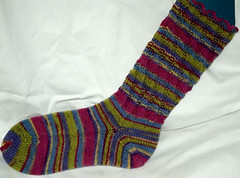
Because I make my own socks, I get to choose my own yarns. I began with some basic, moderately subdued colors, but quickly moved on to the more "interesting" colorways. Opal, Blue Moon, Flat Feet, Red Heart--I like them all, as long as they're moderately to very bright and bold. I knit my socks toes up, one at a time, from a "figure 8" cast-on to an "afterthought" heel: only the leg changes, as I get bored with just plain ribs (the sock above has a spiral rib leg).

KnitPicks, that online emporium of nearly all things knitting, has a wonderful line of specialty sock yarns: Felici. A blend of 75% very soft Merino and 25% nylon for strength, KnitPicks dyes this butter-soft sock yarn in series of limited-edition colorways. This time around, they drew inspiration from the popular British childrens' TV show Doctor Who, and created the Time Traveler colorway for fans that wanted socks similar to the scarf worn by the good Doctor in the 1970s. The scarf is amazing, both for its length (at its longest, about 15 feet) and its colors: the original scarf was created from a bunch of mismatched yarns, but the random colors work well as a whole. It is somewhat a rite of passage for Doctor Who fans to, at some point, knit their own version of the famous Scarf. I crocheted one out of horrid acrylic yarn during my college years--it has long since disappeared (probably raveled and crocheted into an afghan), with no one the wiser until now.

I ordered a couple skeins of the yarn, and was impressed by how similar they are to the scarf colors--the photo at the right is the skein, sitting on a portion of my new Scarf, currently underway. The only missing color was the olive green, so I ordered a skein of KnitPicks Essentials in the Sarge colorway to add in some green.

The plan is to knit this pair of stockings as a 4x1 rib. As I knit socks from the toe up, I started with the Sarge Essentials and knit the toe, then switched to the Felici Time Traveler. At round 65, I knit half of the round with a bit of waste yarn--I will go back later and knit an "afterthought" heel in the Sarge colorway--then continued on up the leg in the 4x1 rib. When I get the leg long enough to reach my knee, I'll switch back to the Sarge and knit a turn-over cuff before starting on the second stocking.

This pair of stockings is fun to knit--the yarns a buttery soft, and the pattern is just complex enough to keep my interest. At the end, I'll have another pair of very loud knee socks to wear with some of my outfits.

Tuesday, May 25, 2010

Dress Journal #2: Brain Dump

The first step in costuming does not involve fabric, pins, a sewing machine, or an iron. It does involve, in my case, paper, pencils (both regular and colored), an eraser, india ink, and a moderate amount of swearing. This is a brain dump, where my ideas are taken out of my head and captured on paper. For me, it's an important step because without it, I'm relying on an overly full memory to keep track of all the details of an outfit. Putting it down on paper solidifies the idea and makes it a bit more real; I also can start to think about what materials I will need to turn the drawing into reality.

Some time this past weekend was devoted to a brain dumping session. I need several new outfits, along with new underpinnings. There's too much--about 25 pieces--to just work from a list, so some sketches are necessary. I also want to try out some trim details before committing to one specific idea, and sketches are the least expensive route.

So, what am I considering? Nothing short of a nearly complete wardrobe for a lady archaeologist/cultural xenologist in 1905. No big puffy sleeves and giant hats full of dead birds: these are practical clothes that can take me from the field to the lecture hall in style and comfort. The list:

Underpinnings:
2 chemises, both trimmed with hand-crocheted lace (more on that later)
2 prs. French drawers
1 petticoat
1 Equipoise basque (basically an unboned corset)
2 prs. loud handknitted stockings
1 pr. black lace handknitted stockings

Field dress:
1 white shirtwaist
1 split skirt
1 Norfolk jacket
1 topee with veiling
1 pr. stout walking boots
1 tie

Lecture/Meeting dress:
1 white shirtwaist (see above)
1 gray tweed vest
1 navy Eton jacket with white braid trim
1 navy walking skirt
1 straw boater,
1 pr. sensible shoes
1 tie (see above)

Cycling outfit:
1 sky blue shirtwaist
1 gray tweed vest (see above)
1 pr. navy bloomers
1 gray tweed Norfolk or Reefer jacket
1 straw boater (see above)
1 pr. black gaiters
1 pr. low-heeled boots
1 tie (see above)

It's a lot of cutting and sewing, but I really need to build a lot of new clothes; it's been 15 years since I last built a wardrobe for this time period, and my figure has changed somewhat in the intervening years. One piece at a time, I will build a new wardrobe.

Monday, May 24, 2010

Dress Journal #1: Steampunk. Steampunk? Steampunk.

After an extended hiatus, I'm preparing to drag the sewing machine out and build myself some new clothes. Not clothes that I would normally wear to work--clothes that I wear to play, since my idea of "play" still includes a good amount of "dress up." This summer I am doing some serious costume-building.

If one were to diagram my friends and my play, it would be a Venn diagram with three very overlapping circles. Some of my fiber friends are also fans of the British TV show Doctor Who; others are in the historical reenacting and fiber circles; a few are in all three. Now there's a fourth circle: steampunk.

Steampunk--as a literary form--is a subgenre of science fiction extrapolating the idea that Charles Babbage's Difference Engine (now considered to be the world's first computer) was built and the design improved upon in the 19th Century. It's a world populated with technology that operates with steam and gears, and a rather Victorian sense of geopolitics: the United States is split into several different countries, depending on the author, and the sun has not set on the British empire. An excellent description of the origins of steampunk can be found in Jess Nevin's essay, "The 19th Century Roots of Steampunk," in Steampunk. Steampunk has taken the historical costuming world by storm.

Steampunk as a venue for costuming is fun, because it draws heavily on 19th and early 20th Century clothing (approximately 1850-1910). It gives me a reason to revamp my wardrobe after a long break from this period, with clothes I can wear for action-shooting, historical reenactments, the odd science fiction convention, and of course steampunk events. As an early 20th Century technical exposition--The Great Pan-kinetic Exposition--is tentatively scheduled to be held sometime in 2011, I have no excuse to not start building clothes appropriate for it and other events.

So this is the start of an actual dress journal. Stay tuned, and follow how I go about refurbishing my wardrobe.